

Why Compliance Audit Sampling Is Giving Way to Full Review
Compliance audit sampling has been the default for decades because reviewing everything was impossible. That constraint has lifted, and the interesting consequence is not speed. It is that coverage stops being an assumption you defend and becomes a fact you can state.
Key takeaways
- Sampling assumes risk is evenly distributed. It never is, which is why audits keep surfacing issues that had been running for years.
- Regulators increasingly ask what compliance can see across the whole population, not what a sample showed.
- Automated review does not improve judgment. It changes what reaches a reviewer’s queue.
- Mitigation and remediation are different controls with different triggers, and conflating them is a common weakness in monitoring programs.
- A finding that is not tracked to closure changes nothing, whatever surfaced it.
Most compliance audits still work the way they did fifteen years ago. Pull a sample, review it by hand, write up what you find. That made sense when the reviewable universe was a few thousand documents a year.
It fits less comfortably now. The volume of reviewable material keeps growing, and the share any team can realistically read keeps shrinking. Nobody sets out to review less. It happens a little more each year without anyone deciding it.
AI does not fix this by replacing auditors. It fixes it by changing what auditors spend their day looking at.
The sampling problem
A 2% sample tells you something about the 2%. Whether it tells you anything about the other 98% depends entirely on whether risk is evenly distributed, and it never is.
Risk clusters. It concentrates in specific regions, specific brands, specific representatives, specific quarters. A random sample is structurally likely to miss a small cluster of serious problems while returning a clean result on a large volume of routine activity. This is why audits so often surface issues that turn out to have been running for two years. The activity was always in the data. Nobody was looking at that part of the data.
Regulators have moved in the same direction. The Department of Justice’s Evaluation of Corporate Compliance Programs asks whether compliance personnel have access to relevant data sources and how a company measures whether its program actually works. The Office of Inspector General’s compliance program guidance for pharmaceutical manufacturers treats auditing and monitoring as ongoing activity rather than a periodic exercise.
Neither document mandates full-population review. Both point at the same question: what can you actually see, and how do you know?
| Sampling | Full-population review | |
| Coverage | A fraction, chosen at random | Every item, scored |
| Time to detection | Next review cycle | As material is processed |
| Reviewer effort | Sorting first, then judging | Judging |
| Risk concentration | Likely to be missed | Surfaced by design |
| What you can evidence | The sample was clean | The population was screened |
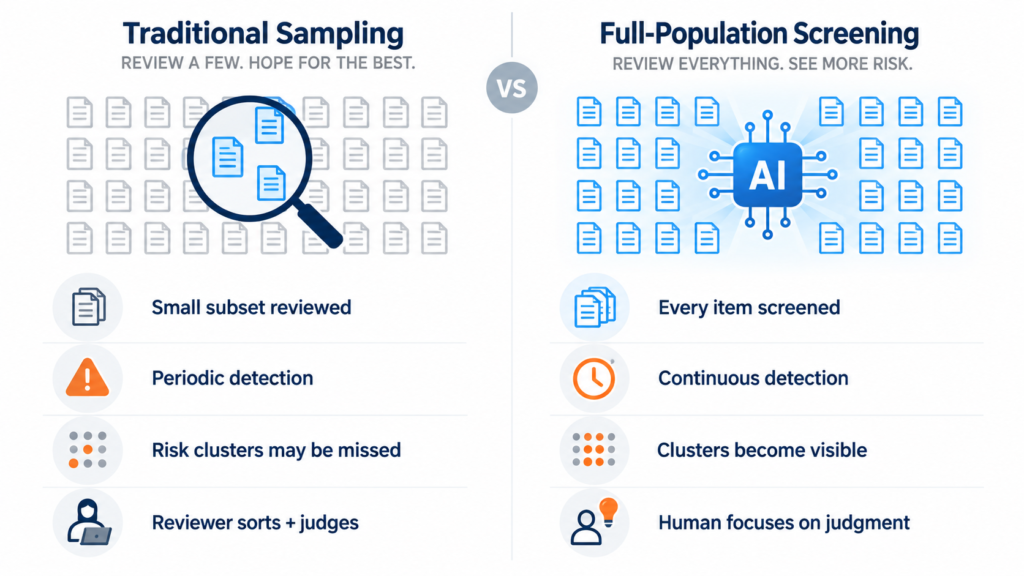
What changes when the whole population is reviewable
Automated review does not make judgments better. It makes the input to those judgments complete.
MonitorMate reviews every email rather than a sample. Each one passes through machine learning models trained on policy and regulatory violation patterns, and the ones scored as high risk are routed to a reviewer. The queue is no longer a sample. It is the subset of the whole that warrants attention.
What the models look for is configurable, including custom keywords and phrases specific to your policies. That matters because the phrasing that signals a problem in one organization is unremarkable in another, and a generic model trained on generic risk produces generic noise.
The practical effects:
- Coverage stops resting on a sampling assumption
- Reviewer time moves to the cases that need a person rather than the sorting that precedes them
- Issues surface through an automated pipeline rather than waiting for the next review cycle
The use cases also run wider than most teams expect. Alongside policy violations, the same review pass catches sensitive information leaving the organization, whether that is patient data, healthcare professional (HCP) personal information, clinical trial data, or pre-approval product information. Insider trading, harassment, and discrimination signals surface the same way. One review serving several oversight obligations at once is a better economic argument than any single use case on its own.
None of this is exotic. It is the same logic that moved fraud detection in banking away from manual review twenty years ago.
The indicators that matter
Reviewing everything only pays off if the screening looks for the right patterns, and in life sciences those are rarely the obvious ones. The useful signals tend to be specific and dull, and many of them only show up when you compare a person’s activity with their own history rather than with a fixed limit.
We set out which indicators work, and why, in missed opportunities in compliance analytics. For auditing purposes the two depend on each other, since screening every item against weak indicators only produces a longer queue.
Asking questions of your own records
Most of the time spent on an audit goes on locating things rather than judging them.
MonitorMate includes document search built on leading AI models, so users can ask questions about documents held in their monitoring records and get detailed answers back in seconds, across monitoring records and other documents in the repository. Administrators control who has that access, which matters because monitoring records often contain the most sensitive material a compliance function holds.
The effect during an audit is small but real. Reconstructing what a policy said two years ago, or finding every monitoring record that touched a particular vendor, used to mean an afternoon in a folder structure. Now it is a question.
For quality teams running a separate audit function, Quality360 covers equivalent ground on that side, including document-backed answers drawn from standard operating procedures, training records, and deviation logs during a live inspection.
Findings still have to go somewhere
The part that gets least attention is what happens after the audit. A finding that sits in a report changes nothing.
MonitorMate handles this end to end, and the sequence matters. A formal global risk assessment produces a Risk Assessment and Mitigation Plan, or RAMP, covering the risk assessment survey, development of the mitigation plan, and its assignment. The total risk score combines inherent risk from the survey with control effectiveness, rather than resting on the survey alone, which is the detail that separates this from a questionnaire that scores intentions.
The monitoring plan and monitoring forms are separate steps that follow. They are calibrated by what the risk assessment found, but they are not part of RAMP.
The distinction worth being precise about is between mitigation and remediation, because the two are routinely run together and anyone who has operated one of these programs will notice. Mitigation is preventive. It falls out of the risk assessment before any monitoring happens, and it addresses a risk you have identified but not yet observed. Remediation is corrective. It follows a monitoring finding and addresses something that has already occurred. Different owners, different records, different closure gates.
Both run with automated workflow and email notification, and results and escalations surface on dashboards available at every level of the compliance organization. When remediation status is visible to leadership without someone building a slide, overdue items get resolved. When it is not, they age quietly.
The risk model itself is question-based, covering speaker programs, grants, sponsorships, and third-party interactions, so the monitoring plan reflects where your exposure actually sits rather than a generic template.
What does not change
Auditors still make the calls. A flag is a hypothesis, not a finding, and the difference between the two is professional judgment applied to context that no model has.
What changes is the ratio. Less time sorting, more time on the cases where experience earns its keep. And a clearer record of not just what was reviewed, but why a reviewer decided what they decided. That record is what auditors and regulators ask for, and it is usually the hardest thing to produce after the fact.
It is also worth saying that full-population review raises volume before it lowers work. The first cycle after switching usually surfaces more than the last sampling cycle did, and that is the system functioning rather than failing. Teams that expect it handle it well. Teams that do not tend to conclude the models are noisy.
Where to start
You do not need to rebuild your monitoring program to get value here. Most teams we work with start narrow: one high-volume activity type, one region, one set of indicators.
The comparison that follows is the useful part. Run automated review alongside your existing sampling for a single cycle and look at what each approach surfaced, what the other missed, and how long each took to get there. That is a small enough commitment to make without a business case, and it produces the evidence for one.
For teams also working out how to govern AI inside their own compliance workflows, we covered the documentation and audit trail side in healthcare compliance auditing for AI-driven workflows.
Frequently asked questions
Does full-population review mean reviewing everything manually?
No. It means everything is screened, and people review what the screening surfaces. The reviewer’s workload is determined by how much warrants attention, not by how much exists.
What happens to the alerts we already get from existing rules?
They usually stay, at least initially. Fixed rules catch obvious breaches reliably and there is no reason to remove them. What model-based review adds is the category of problem a fixed rule cannot see, particularly gradual drift within limits.
How do we know the models are catching the right things?
Test them against what you already know. Run them over a period where you have investigated findings and see whether the issues you eventually caught would have surfaced earlier. If they would not have, the configuration needs work before the program scales.
Is this only viable for large organizations?
No. The case is often stronger for small teams, because a team of three has no spare capacity to notice that a pattern is repeating. At that size the screening does the remembering that nobody has time for.
Run the comparison yourself
Pick one activity type and one region, and run automated review alongside your current sampling for a single cycle. We will help you set it up and then look at the results together: what each approach caught, what it missed, and what the difference tells you about the rest of your program.
Contact us to arrange it.