HCP and HCO Engagement Compliance: Managing the Full Lifecycle
Managing interactions with healthcare professionals and healthcare organizations is not simply an approval exercise.
A compliant engagement may begin with a legitimate business need, but it can quickly involve HCP selection, fair market value considerations, approvals, contracting, event execution, payment, documentation, closeout, transparency reporting, monitoring and audit readiness.
The challenge is keeping all of those steps connected.
When parts of the process live in emails, spreadsheets, regional systems or separate workflows, compliance teams can lose visibility into what was approved, what actually happened, what was paid and whether the final activity remained within the original terms.
For life sciences organizations, effective healthcare engagement compliance therefore requires more than approving an HCP or HCO interaction. It requires a documented lifecycle that connects the original business need to the final payment, reporting and audit trail.
What Does Healthcare Engagement Compliance Actually Cover?
Healthcare engagement compliance refers to the controls and processes used to manage interactions with healthcare professionals and healthcare organizations in a consistent, documented and compliant way.
Depending on the organization and market, these interactions may include:
- Advisory boards
- Speaker programs
- Consulting arrangements
- Educational activities
- Meals and travel
- Sponsorships
- Grants
- Fee-for-service engagements
- Cross-border engagements
- Other transfers of value
Some activities are relatively straightforward. Others can become complex very quickly.
Cross-border engagements, for example, may require teams to capture additional information because requirements vary between jurisdictions. Advisory boards also tend to involve longer workflows, more participants and more documentation, which creates more opportunities for information to become disconnected.
The more steps an engagement contains, the more important it becomes to maintain one consistent record of what was requested, reviewed, approved, contracted, delivered and paid.
Where Does the HCP/HCO Engagement Process Usually Break Down?
Many organizations assume approval is the hardest part of healthcare engagement compliance.
In practice, approvals are often relatively straightforward.
The more difficult part frequently comes after approval, particularly between event execution, payment and closeout.
An approver may have reviewed and approved an engagement correctly, but compliance still needs to know whether the activity ultimately happened as planned.
Questions begin to arise:
- Was the HCP paid the amount that was approved?
- Did the final invoice match the contract?
- Did the activity remain within applicable cap limits?
- Was all required documentation collected?
- Were changes to the engagement documented and reapproved?
- Was the actual spend captured correctly?
- Is the information complete enough for transparency reporting?
- Can the organization retrieve the full record during an audit?
A process can therefore be compliant at the approval stage and still develop significant gaps later.
Why Contracted Value and Actual Payment Need to Stay Connected
One of the practical issues compliance teams encounter is the difference between the value originally contracted and what is ultimately paid.
There can be legitimate reasons for a change. But if the difference is not identified, documented and handled through an appropriate approval process, the organization can lose confidence in the controls surrounding the engagement.
The risk becomes greater when teams have limited visibility across activities.
For example, an individual payment may look acceptable on its own. But repeated engagements involving the same HCP can result in cumulative payments approaching or exceeding internal caps.
Good engagement compliance therefore requires teams to look at both the individual activity and the broader relationship with the healthcare professional or organization.
What Should a Compliant Healthcare Engagement Lifecycle Look Like?
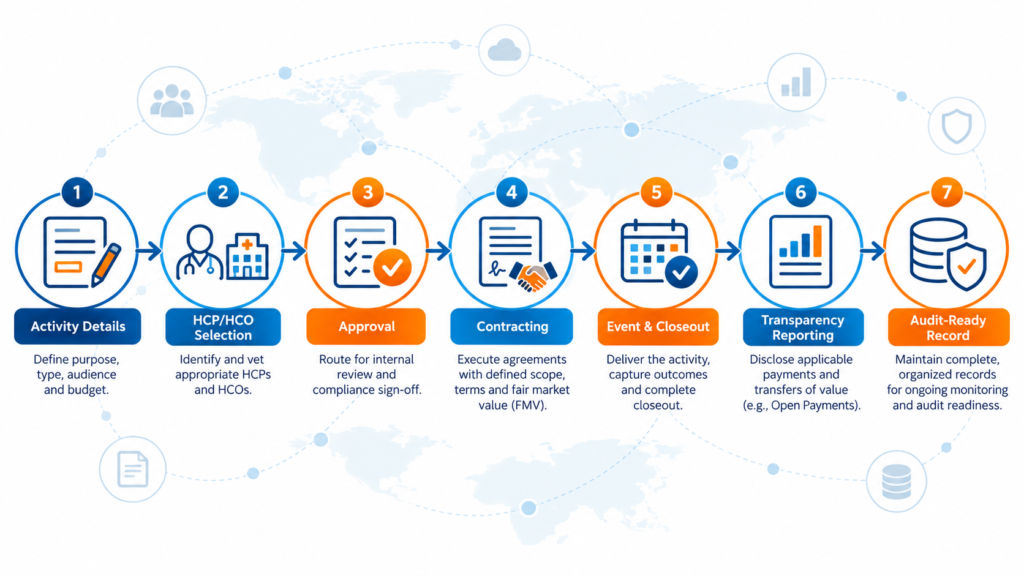
A strong engagement process should create a continuous record from the original business need through final closeout and reporting.
-
Gather the Activity Details
The process should begin by capturing the details of the proposed activity.
That may include:
- Business purpose
- Engagement type
- Proposed participants
- Timing
- Location
- Required documentation
- Proposed materials
- Expected deliverables
- Estimated costs
This initial stage may itself require review or approval.
It is also an important opportunity to determine whether the activity should receive additional monitoring based on its risk profile.
-
Select and Validate the HCP or HCO
The organization should determine whether the healthcare professional or organization is appropriate for the proposed activity.
For HCPs, this may include verifying eligibility and assigning the appropriate tier or rate based on experience, qualifications and the nature of the engagement.
The important point is that selection should be connected to a legitimate business need rather than simply choosing an individual first and trying to justify the engagement afterward.
-
Obtain Informed and Documented Approval
Approval should be more than clicking a button.
Approvers need enough information to understand what they are approving.
Depending on the workflow, the organization may approve the activity first, approve the selected HCPs separately, or review both together.
What matters is that:
- Appropriate people review the activity.
- They have access to the necessary information.
- The rationale is documented.
- Supporting materials remain attached to the engagement record.
- Higher-risk activities can trigger additional review or monitoring.
-
Complete Contracting
Once the engagement has been approved, the appropriate contract should be prepared and reviewed.
Legal teams may need to review the agreement depending on the organization and engagement type.
The final contract should remain connected to the engagement record so the approved rate, services, deliverables and other terms can later be compared with the actual activity.
-
Capture Event and Closeout Information
This is one of the areas where processes frequently become difficult.
Once the activity occurs, teams need to capture what actually happened rather than relying only on what was originally planned.
Closeout may include:
- Attendance or participation information
- Final activity documentation
- Deliverables
- Supporting evidence
- HCP invoices
- Expenses
- Actual payments
- Any deviations from the approved activity
The invoice and final payment should be compared with the contract and approved values.
Where differences exist, the workflow should allow the organization to review the discrepancy and determine whether discussion, documentation or reapproval is necessary.
-
Prepare for Transparency Reporting
Transparency creates another layer of complexity because reporting requirements differ between countries and jurisdictions.
Engagement and closeout data may need to be transformed into formats required by local or national reporting authorities.
This becomes much easier when accurate information has already been captured throughout the engagement rather than reconstructed shortly before a reporting deadline.
-
Maintain an Audit-Ready Record
Documentation should not become an audit project.
The engagement record should make it possible to reconstruct the activity from beginning to end:
- Why did the engagement occur?
- Who was selected?
- Who approved it?
- What was contracted?
- What actually happened?
- What was paid?
- Were exceptions identified and resolved?
- Was the appropriate transparency information captured?
When those records are scattered across inboxes, spreadsheets and shared folders, even a compliant activity can become difficult to defend.
What Risks Should Compliance Teams Monitor?
Managing HCP and HCO engagement compliance also requires looking beyond individual approvals.
Patterns across activities can reveal risks that are not obvious when each engagement is reviewed independently.
Organizations should consider monitoring for issues such as:
- Repeated or excessive use of the same HCP
- Payments exceeding contracted values
- Payments approaching or exceeding internal caps
- Activities without a clear business need
- Engagements approved after commitments were made
- Missing or incomplete documentation
- Missing deliverables
- Unusual preparation time for an activity type
- Repeated exceptions
- Inconsistencies between approved, contracted and actual values
Monitoring these patterns provides a much more useful picture of compliance risk than treating every engagement as an isolated transaction.
How Can Companies Keep Compliance From Slowing the Business Down?
One of the most common concerns about HCP/HCO engagement compliance is speed.
Business teams need to work with providers and organizations. Compliance teams need to make sure those interactions follow appropriate controls.
The answer should not be removing controls. It should be designing the process so people know what is required before an engagement becomes urgent.
Starting early is one of the simplest ways to reduce delays.
A team that begins contracting, documentation and approval shortly before an event will naturally experience more friction than a team that starts the process during activity planning.
Technology can also remove unnecessary administrative work.
A healthcare engagement platform can help by:
- Bringing approval information into one workflow
- Alerting people when an action is required
- Keeping documents associated with the engagement
- Maintaining a clear history of actions and approvals
- Connecting information across the engagement lifecycle
- Integrating with other relevant systems
The objective is not automation for its own sake.
The objective is to reduce duplicate work while ensuring the necessary compliance controls remain visible and documented.
Why Email-Based Approvals Become Difficult to Manage
Email may work when engagement volume is very low.
But as activity grows, email creates several practical problems.
Approvals may become separated from supporting documents. People may work from different document versions. The reasoning behind a decision may be difficult to reconstruct later. Closeout information may never be connected back to the original approval.
The organization then has an approval, a contract, an invoice and an event record—but no single place that shows how those pieces connect.
That fragmentation becomes particularly challenging during audits and transparency reporting.
A structured engagement workflow provides one record of the activity instead of requiring compliance teams to reconstruct it afterward.
A Real-World Example: Moving Cap Management Out of Spreadsheets
In one Cresen implementation, a life sciences organization was managing HCP cap information through separate spreadsheets.
That approach made it difficult to maintain visibility as engagements and spend accumulated.
The solution combined a more automated cap-management process with engagement and spend information. Spend could be catalogued as it entered the process, while the engagement workflow provided better visibility into HCP activity and applicable limits.
The result was a more structured process that helped reduce cap overages and reduced the compliance risk created by maintaining related information across separate files.
The lesson is not simply that spreadsheets are bad.
The lesson is that once engagement volume becomes significant, the organization needs to connect the approved activity with cumulative HCP activity and actual spend.
A Second Example: Standardizing a Global Engagement Process
Another organization operated different engagement and nomination processes across major regions, with some workflows varying even further at the individual country level.
That created complexity for both local teams and global compliance.
Before implementing a technology solution, Cresen worked with the organization during requirements gathering to reassess those processes rather than simply replicating every existing workflow.
Where appropriate, the organization was able to normalize its approach while retaining necessary differences.
Those processes were then implemented within EngageMate, creating:
- Better visibility into global activity
- More consistent workflows
- Clearer action histories
- Centralized engagement information
- Less duplication
- Greater understanding of how the overall process operated
This illustrates an important principle in compliance technology implementations: software should not simply automate whatever process already exists.
Sometimes the biggest opportunity is to simplify and improve the process before automating it.
The Mistake of Automating a Poorly Designed Engagement Process
Organizations understandably want software to match their existing process.
But replicating every existing step is not always the right approach.
If a process already contains unnecessary approvals, duplicate data entry, inconsistent regional practices or disconnected workflows, automating it may simply make an inefficient process run faster.
Implementation should therefore begin with a process question:
Does every step still serve a necessary business or compliance purpose?
Technology should reinforce a well-designed control environment rather than preserve inefficiency.
How EngageMate Supports Healthcare Engagement Compliance
Cresen’s approach is based on managing healthcare engagements as a connected lifecycle rather than a series of disconnected approvals.
EngageMate is designed to bring the information and workflows required for HCP/HCO engagements into a more centralized environment.
Depending on the organization’s requirements, this can include:
- Engagement and activity information
- HCP selection
- Approval workflows
- Contracting-related processes
- Action notifications
- Documentation
- Closeout
- Payment-related information
- Audit trails
- Integration with other systems
One of the practical benefits of this approach is reducing duplicate work.
Information captured earlier in the engagement can remain available later instead of being recreated for contracting, closeout, transparency or audit purposes.
The platform can also support safeguards around limits and overages so exceptions can be identified and routed for appropriate review rather than discovered after the process is complete.
Why Flexibility Matters in a Changing Compliance Environment
Healthcare compliance does not remain static.
Internal policies change. Reporting requirements evolve. Business models expand. Organizations enter new countries. New engagement types appear.
An engagement system therefore needs to adapt without forcing the organization to rebuild its entire process every time a requirement changes.
Cresen’s approach with EngageMate is designed around configurable workflows that can evolve as client requirements change.
The objective is to maintain appropriate controls without creating a rigid process that prevents the business from adapting.
Cresen’s View: Engagement Compliance Is About the Whole Lifecycle
Our view is that effective healthcare engagement compliance is not simply about approving individual HCP or HCO interactions.
It is about connecting business needs with transparency and compliance requirements across the complete lifecycle.
That means linking:
- Business need
- HCP/HCO selection
- Appropriate rates and terms
- Informed approvals
- Contracting
- Event execution
- Documentation
- Payment
- Closeout
- Monitoring
- Transparency reporting
- Audit readiness
The challenge is creating that connected process without forcing people to duplicate work across multiple systems.
That is where an engagement management platform provides its greatest value.
When information follows the engagement from the initial request through closeout and reporting, compliance teams gain better visibility while business teams gain a clearer and more predictable process.
What Should You Look for in Healthcare Engagement Compliance Software?
Organizations evaluating engagement technology should ask questions that go beyond whether the system can route approvals.
Consider whether the platform can:
- Support the complete engagement lifecycle
- Capture the information needed for informed approval
- Maintain supporting documentation
- Manage HCP selection and applicable rates
- Connect approved, contracted and actual values
- Identify overages or discrepancies
- Support closeout workflows
- Integrate with related systems
- Maintain audit trails
- Support transparency data requirements
- Adapt to regional or regulatory changes
- Provide visibility across multiple engagements and geographies
A platform that only digitizes approval may solve one step while leaving the larger compliance problem untouched.
How Do You Manage Healthcare Engagement Compliance Effectively?
The strongest approach is to treat HCP and HCO engagement compliance as one connected process rather than a collection of administrative tasks.
- Start with a legitimate business need.
- Select the appropriate provider or organization.
- Make sure approvers have the information necessary to make an informed decision.
- Document the agreement.
- Capture what actually happens during the engagement.
- Compare the final payment with the approved and contracted terms.
- Maintain documentation for transparency and audits.
- And monitor activity across engagements so recurring patterns do not remain hidden.
- Technology can make that process easier, but the technology needs to support a well-designed compliance model.
At Cresen Solutions, that is the purpose behind EngageMate: helping life sciences organizations connect the business and compliance sides of healthcare engagements without creating unnecessary duplicate work.
If your organization is managing HCP or HCO engagements through disconnected emails, spreadsheets and regional workflows, Cresen can help assess the current process and determine where standardization, workflow improvements and engagement technology can strengthen compliance while making the process easier to manage.