How to Manage Compliance Risk in Cross-Border HCP Engagements
Most cross-border compliance problems are not detection failures. They are approval failures. By the time monitoring surfaces an issue with an international advisory board or a congress sponsorship, the organisation has already agreed to it, contracted for it, and usually paid for it.
Key takeaways
- Cross-border risk is largely determined during nomination, tiering, and contracting, well before any monitoring runs.
- Fair market value is the most common failure point, because the same specialty commands different rates in different markets and a single global rate card satisfies neither.
- Sanctions and debarment screening is not one control. Registries are national, so a physician clear in one jurisdiction may not be clear in another.
- Local requirements such as tax treatment, payment routing, and specialty coding change the shape of an engagement rather than sitting alongside it.
- Engagement data is the source for both monitoring and transparency reporting, so gaps at approval propagate into both.
A single global HCP engagement now routinely touches several jurisdictions at once. A physician nominated in one country speaks at a virtual congress hosted in another, under a contract governed by a third, paid through an affiliate in a fourth. Each of those steps carries its own rules, and the rules change on their own schedules rather than together.
Most oversight still treats this as a monitoring problem. The more useful question is what the approval chain allowed in the first place.
Where borders actually bite in the engagement lifecycle
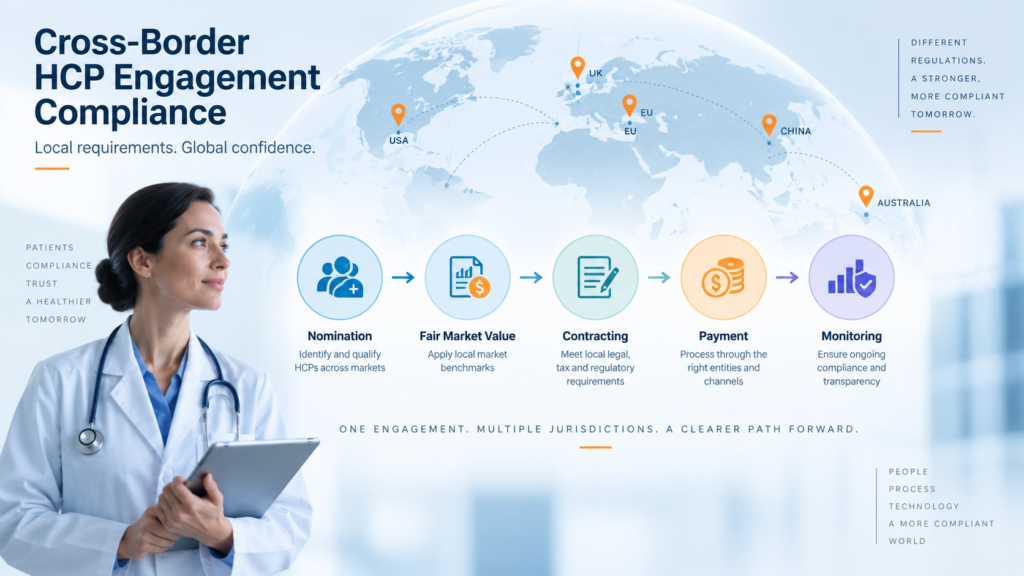
The engagement lifecycle runs from annual planning through needs assessment, content review, nomination and tiering, contracting, execution, and finally payments and reconciliation. Cross-border complexity does not spread evenly across those stages. It concentrates in four.
Nomination and qualification: Tiering criteria are usually set globally while the inputs are national. Specialty codes differ by country, as do the registries used to verify credentials, publication records, and institutional affiliations. A tiering model that assumes one national taxonomy produces inconsistent tiers the moment it crosses a border.
Fair market value: This is the most frequent failure point. The same specialty commands genuinely different rates in different markets, driven by local practice economics rather than by anything a global policy can normalise. A single worldwide rate card overpays in some markets and underpays in others, and both directions create problems. Underpaying makes engagements harder to fill and pushes teams toward exceptions. Overpaying is the one a regulator asks about.
Contracting: Local tax treatment, withholding requirements, and payment routing are not administrative details that follow the contract. They shape it. An engagement structured for one market frequently has to be restructured for another, and the version that gets signed locally may not match what was approved centrally.
Payments and reconciliation: What was approved and what was actually paid diverge more often in cross-border work than in domestic engagements, because more hands touch the transaction and more systems sit between approval and disbursement.
EngageMate is built around this lifecycle rather than around a single stage. It handles needs assessment, nomination and tiering, FMV calculation, contracting, execution, and closeout in one audit-ready workflow, with configurable forms, qualification criteria, and language translations so that local requirements can be built into the process instead of handled around it.
Screening is a different control in every market
Sanctions and debarment screening looks like a single global check. It is not.
Registries are national. A physician who is clear against one country’s medical board may carry an unresolved sanction in another, and the two systems have no visibility into each other. So screening across borders means screening in each relevant jurisdiction, against sources that differ in what they publish, how current they are, and what format they arrive in.
The US layer of this is unusually deep and unusually difficult. Sanction data sits across state medical boards and the OIG, and the hard part is not finding whether a sanction exists. It is understanding what the sanction actually says. Court sanction orders run long, and a business user deciding whether to engage a physician next month is not going to read one.
Our AI-powered sanctions and exclusion data lake consolidates state medical board and OIG data into one place and condenses those court orders into short summaries a non-lawyer can act on. That covers the US. For engagements in other markets, the equivalent local sources need checking as part of the same due diligence step, which is why third-party due diligence is integrated into the workflow rather than handled separately.
The practical point is that a screening control described as global is usually a screening control with one deep market and several thin ones. It is worth knowing which is which in your own programme.
What happens to the data afterwards
Engagement data does not stop being useful when the engagement closes.
Activity and spend from EngageMate flow into MonitorMate for risk assessment and monitoring, and into SpendMate for transparency reporting. That connection matters more in cross-border work than anywhere else, because the same activity may be reportable in more than one jurisdiction, on more than one schedule, under more than one set of category definitions.
It also means the quality of what gets captured at approval determines the quality of both downstream outputs. An engagement categorised inconsistently at nomination is categorised inconsistently in the disclosure eighteen months later, and by then nobody remembers why. We covered how that plays out in reporting in our piece on streamlining compliance management across the suite.
Where to start
You do not need to redesign the whole programme to make progress. Pick one or two engagement types that genuinely cross borders, usually global speaker or advisory programmes, or international congress sponsorships, and map how they run today.
Three questions tend to surface the gaps quickly. Where does a global policy get reinterpreted locally, and by whom? Which stages currently happen in email rather than in a system? And if an auditor asked why a particular HCP was tiered as they were, how long would it take to answer?
The answers usually point at one or two stages rather than at the whole lifecycle, which makes the work manageable.
Frequently asked questions
Should fair market value be set globally or locally?
Both, in layers. The methodology and tier definitions belong globally so that engagements stay comparable. The rates belong locally, because the underlying practice economics are local. A single global rate table is the version that causes problems.
Does a virtual engagement reduce cross-border complexity?
It reduces travel and logistics, not regulatory exposure. A virtual advisory board still involves an HCP in one jurisdiction, a sponsor in another, and often a contracting entity in a third. In some respects it increases complexity, because it becomes easier to include participants from markets the programme was never designed for.
How much of this needs to be a system rather than a policy?
Anything where a local team has to interpret a global rule under time pressure. Policies describe the intent. What determines the outcome is whether the form someone fills in on a Tuesday afternoon makes the compliant path the easy one.
Talk to us about your engagement lifecycle
Walk us through how one cross-border engagement type runs today, from nomination to payment. We will tell you which stages carry the most risk in your setup and where the approval chain is doing less work than it appears to.
Contact us to arrange it, or read the EngageMate white paper first if you would rather see the detail.