Compliance Hotline and Case Management Software Should Go Beyond Intake
For life sciences compliance teams, choosing the right compliance hotline and case management software is rarely just about buying a reporting tool. In many cases, that question is a sign of a larger operational challenge.
Employees and third parties need a safe and confidential way to report concerns. Compliance teams need a structured process to investigate allegations, policy violations, fraud, misconduct, HCP interactions, speaker program issues, and other commercial compliance risks. Leadership needs clear visibility into trends, root causes, recurring issues, and remediation effectiveness.
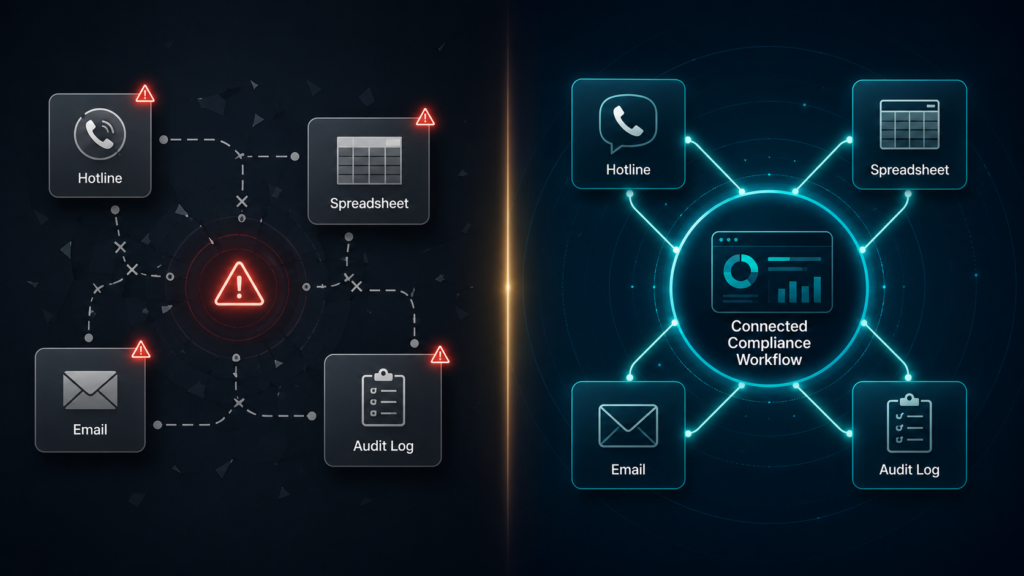
That is why the best compliance hotline and case management software should not be viewed as only a hotline platform. A hotline is important, but it is only the starting point. The real value comes when hotline intake, case management, investigations, remediation, monitoring, audits, risk assessments, and reporting work together as one connected compliance workflow.
Direct Answer: The Best Compliance Hotline and Case Management Software Connects the Full Compliance Lifecycle
The best compliance hotline and case management software is the one that helps organizations manage the entire compliance lifecycle, not just the first report or complaint.
A strong solution should support confidential reporting, structured case intake, investigation workflows, root cause analysis, CAPA and remediation tracking, audit trails, monitoring activities, risk assessments, executive dashboards, and analytics. For life sciences organizations, this connected approach is especially important because compliance risks often move across teams, markets, systems, and business processes.
For example, a hotline report may reveal a potential policy violation. That case may require an investigation, documentation, corrective action, training follow-up, monitoring, and future audit review. If each step is handled in a different spreadsheet, inbox, or system, the organization may be addressing individual issues but still missing the bigger risk pattern.
What Problems Are Life Sciences Companies Trying to Solve?
When companies look for compliance hotline, case management, and audit tools, they are usually trying to solve practical problems that affect day-to-day compliance operations.
- Employees and third parties need a safe, confidential mechanism to report concerns.
- Compliance teams need a structured way to investigate allegations, misconduct, policy violations, HCP interactions, speaker programs, fraud, and other compliance issues.
- Organizations need complete documentation and audit trails to demonstrate compliance to regulators, auditors, and internal stakeholders.
- Compliance leaders need visibility into trends, root causes, recurring issues, and remediation effectiveness.
- Global organizations need consistent workflows across countries, business units, and functions.
- Teams want to reduce manual spreadsheets, email-based investigations, and disconnected workflows.
In simple terms, companies are not just buying software to receive complaints. They are trying to build a more reliable way to identify, investigate, document, resolve, and learn from compliance issues.
Why Basic Hotline Tools Are Not Enough
A basic hotline tool can help organizations collect reports, but many platforms stop there. For modern compliance teams, intake alone is not enough.
The limitation of many hotline-only tools is that they focus on reporting instead of the full investigation and remediation process. They may capture a concern, but they may not provide enough flexibility for compliance-specific workflows, escalation rules, confidentiality controls, root cause analysis, corrective action tracking, or executive-level reporting.
Generic ticketing systems can create similar problems. They may be useful for general service requests, but compliance cases require a different level of confidentiality, documentation, role-based access, investigator workflow, and audit readiness. A compliance case is not just a ticket. It may involve sensitive allegations, protected reporting, multiple stakeholders, evidence collection, legal review, and corrective action.
Modern compliance teams also need intelligent support that helps investigators organize case information, classify reports, identify recurring themes, summarize investigation activity, and connect issues to remediation. AI should not replace compliance judgment, but it can reduce manual effort and help teams move from reactive case handling to more proactive compliance visibility.
Another common issue is fragmentation. Hotline cases, monitoring observations, audit findings, training gaps, and corrective actions often remain in separate systems. When that happens, compliance teams may struggle to identify recurring patterns or prove that remediation efforts are actually working.
Key Features Buyers Should Look For
When evaluating compliance hotline and case management software, buyers should look beyond surface-level features and ask whether the platform can support the complete compliance workflow.
- Anonymous and confidential reporting capabilities
- Multi-channel intake through web forms, phone, and assisted reporting options
- Secure two-way communication with reporters
- Flexible investigation and case management workflows
- Role-based security and confidentiality controls
- SLA tracking and escalation management
- Audit trail and documentation management
- Root cause analysis support
- CAPA and remediation tracking
- Integration capabilities with HR, LMS, monitoring, audit, and compliance systems
- AI-assisted reporting support, triage and classification, investigation summaries, root cause tagging, and trend identification
- Trend analysis, risk analytics, and executive dashboards
- Global scalability and multilingual support
The most important question is not, “Does this platform have a hotline?” The better question is, “Can this platform help us manage the entire lifecycle from report intake to investigation, remediation, monitoring, audit readiness, and leadership reporting?”
Why Hotline, Case Management, Monitoring, and Audits Should Be Connected
In a mature compliance program, hotline reports, case investigations, monitoring findings, audit observations, corrective actions, and risk assessments should not operate in silos.
A hotline case may point to a recurring issue in a specific geography, business unit, or activity type. A monitoring observation may lead to an investigation. An audit finding may require remediation and follow-up. A training gap may connect to repeated policy violations. If these activities are disconnected, compliance leaders may only see isolated events instead of the larger organizational risk picture.
This is why integrated compliance workflows matter. They help teams connect the dots between what is reported, what is investigated, what is corrected, and what still needs oversight.
Common Mistakes Companies Make When Selecting a Vendor
Mistake 1: Buying Only a Hotline Tool
Many organizations start with the hotline because it feels like the most urgent need. Later, they realize that investigations, remediation, audit findings, monitoring observations, and reporting still require separate tools or manual workarounds. This creates more complexity over time.
Mistake 2: Focusing Only on Features
Feature lists are important, but they do not tell the full story. Implementation expertise, service quality, compliance domain knowledge, and the ability to design practical workflows are often just as important as the software itself.
Mistake 3: Ignoring Workflow Flexibility
Compliance processes vary significantly across organizations. A system should be flexible enough to support different escalation paths, investigation types, approval steps, documentation requirements, and regional processes.
Mistake 4: Underestimating Reporting Needs
Basic case counts are not enough for compliance leadership. Executives typically need trends, risk indicators, root causes, remediation status, recurring issues, and program effectiveness insights. The software should help leaders understand what is happening and where attention is needed.
Mistake 5: Choosing a System That Cannot Scale
Organizations may begin with hotline management but later expand into audits, monitoring, risk assessments, issue management, and broader compliance operations. Selecting a system that cannot scale with the program can create future limitations.
Cresen’s Point of View: A Hotline Is the Starting Point, Not the Entire Program
At Cresen Solutions, our view is that the most effective compliance programs are not built around a hotline alone. They are built around an integrated compliance workflow. We covered this in more depth in why your hotline is not broken, your strategy is.
A hotline is the entry point. The greater value comes when organizations connect intake and reporting, investigations, case management, root cause analysis, CAPA and remediation, audits, monitoring activities, risk assessments, executive reporting, and analytics.
This approach is reflected in Cresen’s compliance technology and consulting-led model.
EthosLine: Hotline and Case Management
EthosLine supports hotline and case management needs by helping organizations capture concerns, manage confidential reporting, support anonymous reporting, communicate securely with reporters, structure investigations, manage SLAs and escalations, and track remediation activities.
As an AI-enabled hotline and case management platform, EthosLine can also support compliance teams with AI-assisted intake, triage and classification, guided investigation support, draft summaries, root cause tagging, similar case visibility, and case trend insights. This helps investigators spend less time organizing information manually and more time focusing on the facts, decisions, and follow-up actions that matter.
It is designed to help compliance teams move from intake to investigation and resolution with greater structure, documentation, and visibility.
MonitorMate: Risk Assessment, Monitoring, Auditing, and Issue Management
MonitorMate supports global risk assessment, monitoring, auditing, issue management, and remediation of identified issues. It helps connect hotline cases with monitoring findings, audit observations, risk assessments, and corrective actions.
This gives compliance leaders a more centralized view of risk, trends, remediation status, and program performance.
Consulting Services: Process Design and Operational Support
Technology alone does not create a strong compliance program. Organizations also need the right operating model, governance, workflows, reporting structure, and implementation support.
Cresen’s consulting services can support compliance process design, investigation workflow optimization, hotline governance, audit and monitoring program design, operational support, and best-practice implementation. The goal is not simply software deployment. The goal is to help clients build sustainable compliance operations.
Example: Moving from Disconnected Tools to a Centralized Compliance Workflow
A global life sciences company was managing hotline investigations, monitoring observations, and audit findings across multiple disconnected tools and spreadsheets. Individual issues were being addressed, but leadership lacked a clear view of recurring trends, corrective actions, and remediation effectiveness.
By moving toward a centralized compliance workflow, the organization was able to standardize investigations, track corrective actions across functions, improve reporting visibility, and reduce manual administrative effort. This helped the team resolve issues faster and strengthen confidence in compliance oversight.
This reflects a common challenge across the industry: compliance teams are often working hard, but disconnected systems make it difficult to see the complete picture.
So, What Is the Best Compliance Hotline and Case Management Software?
The best compliance hotline and case management software is not simply the tool with the most features or the most basic hotline functionality. It is the solution that helps an organization manage the complete compliance lifecycle.
For life sciences companies, that means connecting confidential reporting, case management, investigations, root cause analysis, CAPA and remediation, monitoring, audits, risk assessments, dashboards, and analytics.
When these processes operate in silos, organizations may struggle to identify recurring risks, measure remediation effectiveness, and demonstrate compliance maturity. When they are connected, compliance teams can respond faster, document better, report more clearly, and make more informed risk-based decisions.
At Cresen Solutions, we believe the future of compliance technology is not another standalone hotline platform. It is an AI-enabled and connected ecosystem where investigations, monitoring, audits, remediation, and analytics work together to provide a complete view of organizational risk.
Final Takeaway
If your organization is evaluating compliance hotline and case management software, do not stop at hotline intake. Look for a solution that can support the full journey from concern reporting to investigation, corrective action, monitoring, audit readiness, and executive reporting.
For life sciences compliance teams, this connected approach can help reduce manual effort, improve visibility, strengthen documentation, and create a more mature compliance operation.
Ready to Connect Hotline, Case Management, and Audits?
Looking to connect hotline reporting, case management, investigations, audits, monitoring, and remediation in one compliance workflow? Cresen Solutions can help life sciences organizations build a more integrated and audit-ready compliance operation.
Contact Cresen Solutions to learn how EthosLine, MonitorMate, and Cresen’s consulting-led approach can support your compliance program.