Commercial Compliance Software for Life Sciences: Why Legacy Platforms Are No Longer Enough
Commercial compliance software was supposed to make life sciences organizations safer, more efficient, and more inspection-ready. In many organizations, it still does part of that job. It captures approvals, stores documents, assigns workflows, and helps teams show that required controls were followed.
But the question for compliance leaders has changed. The issue is no longer simply: Do we have a system? The more important question is: Can our system help us see risk early enough to act?
That is where many legacy commercial compliance platforms are starting to fall short. They were built primarily to document activity, enforce static workflows, and support periodic review. Today, life sciences compliance requires a more connected operating model – one that brings together data, workflows, risk signals, and evidence across the full commercial and medical ecosystem.
When software only captures what happened after the fact, teams still end up living with familiar operational gaps: scattered data, manual reconciliation, disconnected reviews, delayed investigations, and limited visibility into recurring issues.
The result is not just inefficiency. It is risk exposure hiding inside day-to-day execution.
Legacy Platforms Were Built for Documentation, Not Active Risk Visibility
Many older compliance systems were designed around a reasonable goal: make sure the organization can document approvals, capture required information, and maintain a defensible record.
That is still important. Documentation remains essential in life sciences compliance. The problem is that documentation alone is no longer enough.
Commercial teams, medical affairs teams, compliance teams, legal teams, finance teams, and regional stakeholders now operate across more markets, more channels, more vendors, and more complex HCP/HCO engagement models. At the same time, transparency requirements, industry codes, internal policies, and enforcement expectations continue to raise the bar for accountability.
A system that only records transactions after they happen does not give compliance teams enough leverage. Leaders need to understand where risk is forming, which patterns are emerging, which controls are weakening, and where intervention is needed before an issue becomes larger.
The modern expectation is not just recordkeeping. It is operational visibility.
Shadow Processes Create Audit and Execution Risk
One of the most common signs that a compliance platform is no longer keeping up is the rise of shadow processes.
These are the workarounds teams create when the official system cannot handle the reality of the business. They may be practical in the moment, but they are difficult to govern and even harder to defend later.
- Extra approvals managed through email
- Local trackers for field or medical activity reviews
- Spreadsheets used for new risk flags or country-specific requirements
- Manual sign-offs that never flow back into the main system
- Offline evidence folders created to prepare for audits or investigations
The risk is not always that people are ignoring compliance. Often, the opposite is true. Teams are trying to do the right thing, but the system is not flexible or connected enough to support the way work actually moves.
Over time, those workarounds become a second compliance environment – one that is harder to monitor, harder to audit, and harder to scale globally.
Fragmented Data Prevents Teams From Seeing the Full Risk Picture
Commercial compliance risk rarely sits neatly in one system.
A single issue may involve an HCP engagement request, FMV review, spend record, contract, event, email, field interaction, audit observation, hotline report, CAPA, or remediation commitment. If those data points live in separate systems, teams can miss the relationship between them.
That fragmentation is one reason compliance teams spend so much time reconciling information instead of acting on it.
- Monitoring activity may sit in one tool.
- Transparency reporting and aggregate spend may sit in another.
- HCP/HCO engagement workflows may be managed separately.
- Case management may not connect to remediation or CAPA.
- Audit findings may not link back to recurring behavior, training gaps, or business process weaknesses.
When these workflows do not connect, blind spots grow. A team may know that an approval was completed, but not whether similar issues are repeating across a region. A team may see a spend exception, but not connect it to a broader engagement pattern. A team may close a CAPA, but not know whether the underlying behavior has truly changed.
The issue is not a lack of effort. It is a lack of connected visibility.
The Human Cost: Burnout, Delays, and Missed Signals
Behind every disconnected compliance process is a team carrying the operational burden.
Compliance professionals are often pulled into manual reconciliation, document chasing, follow-up emails, spreadsheet updates, sample reviews, and evidence preparation. Instead of spending more time on risk strategy, training, business partnership, and proactive remediation, they are forced into administrative firefighting.
Field and medical teams feel the pressure too. When systems are hard to use, rules are difficult to interpret, and guidance is not available in the flow of work, compliance can start to feel like a barrier rather than a practical support function.
That is when behavior can shift in the wrong direction. People delay documentation. They use informal channels. They under-report because the process feels too heavy. They improvise when they are not sure what is allowed.
None of this is sustainable for a modern life sciences organization.
What Modern Commercial Compliance Software Must Deliver
A modern commercial compliance platform needs to do more than store records. It must help teams manage risk as work is happening, not only after the reporting cycle, audit, or investigation begins.
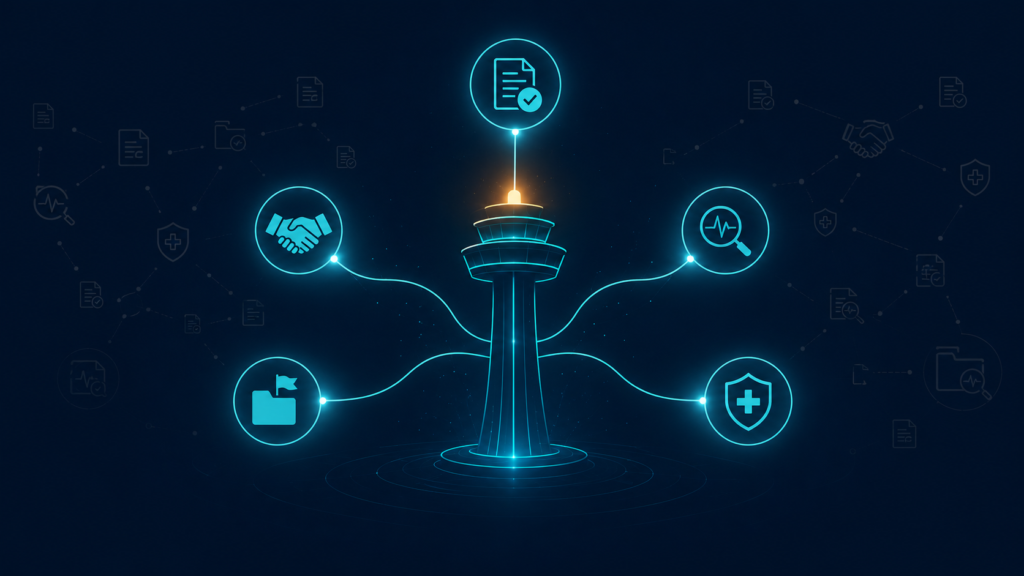
The next generation of commercial compliance software should deliver five core capabilities:
- Connected workflows across the compliance ecosystem
Monitoring, transparency reporting, HCP/HCO engagement, risk assessments, case management, audits, CAPA, and remediation should not operate as disconnected functions. They should support a shared view of risk, ownership, and evidence. - Continuous visibility into patterns and exceptions
Teams need the ability to identify emerging trends, recurring gaps, unusual activity, documentation issues, and risk signals earlier in the process. - Role-based execution for global and local teams
Global consistency matters, but local requirements also matter. The right system should support regional workflows without forcing every market into fragile manual workarounds. - Audit-ready evidence without last-minute reconstruction
Compliance teams should be able to see who did what, when it happened, what decision was made, what evidence was reviewed, and what remediation followed. - Practical AI that supports human judgment
AI should not replace compliance professionals. It should help them prioritize, identify patterns, summarize evidence, surface policy guidance, and focus attention where risk signals are strongest.
Where AI Should Fit in Life Sciences Compliance
AI-enabled compliance technology has become part of nearly every compliance technology conversation, but the strongest use case is not replacing the compliance function. It is improving the quality, speed, and consistency of compliance decision-making.
In a life sciences environment, AI-enabled compliance technology can help teams:
- Review large volumes of activity data and surface exceptions
- Identify recurring themes across cases, audits, CAPAs, and monitoring observations
- Support policy and SOP Q&A for business users
- Summarize documentation and evidence for review
- Prioritize higher-risk activity for human review
- Track remediation commitments and training effectiveness
The right AI model for compliance is not a black box making unsupervised decisions. It is a controlled, explainable layer that helps teams move faster while preserving accountability, review, and governance.
Turning Compliance Software Into a Strategic Advantage
This is where Cresen Solutions focuses its work.
Cresen helps life sciences organizations move beyond disconnected tools and reactive compliance processes by connecting the core workflows that drive commercial compliance, transparency, monitoring, risk, case management, and quality execution.
Our platform ecosystem is designed to support a more integrated operating model:
- SpendMate – for global transparency reporting, aggregate spend analytics, validation, disclosure readiness, and reporting workflows.
- EngageMate – for HCP/HCO engagement management, approvals, FMV, contracts, documentation, payments, invoicing, and closeout.
- MonitorMate – for compliance monitoring, risk scoring, live and virtual interaction monitoring, communications oversight, and remediation visibility.
- EthosLine – for Hotline reporting, case management, routing, investigation workflow, and issue tracking.
- Quality 360 – for deviations, CAPA, audit findings, RCA, training effectiveness, remediation tracking, and quality risk visibility.
- Life Sciences GPT – for policy guidance, regulatory updates, SOP support, and AI-enabled training and knowledge management.
The objective is not to add another disconnected system. It is to help compliance and quality leaders create a more connected execution layer around the systems and processes they already depend on.
When monitoring, spend transparency, engagement management, case intake, remediation, audits, CAPA, and policy guidance are connected, teams gain a clearer view of what is happening across the business and where action is needed.
That means fewer surprises, stronger evidence, faster triage, and better alignment between policy and daily execution.
The Bottom Line
Legacy commercial compliance software helped organizations document work. Modern life sciences compliance now requires more than that.
Teams need systems that connect risk signals, guide execution, reduce manual reconciliation, support global and local requirements, and provide evidence before questions become urgent.
The future of commercial compliance software is not just better recordkeeping. It is connected visibility, proactive risk management, and smarter support for the people responsible for protecting the business.
For life sciences organizations managing complex HCP/HCO engagement, global transparency reporting, monitoring, audits, CAPA, and case management, the question is no longer whether software is in place.
The question is whether that software is truly helping the organization see and manage risk early enough to act.
Call to Action
| Ready to strengthen your commercial compliance operating model?
Cresen Solutions helps life sciences teams connect transparency reporting, HCP/HCO engagement, monitoring, case management, risk visibility, quality execution, and AI-enabled policy support into a more proactive compliance model. If your team is evaluating how to reduce manual work, improve audit readiness, or gain better visibility across commercial compliance workflows, Contact Us to start the conversation. we would be glad to share a tailored overview.
|