Are You Ready to Centralize Compliance Monitoring?
Most organizations that struggle to centralize compliance monitoring didn’t pick the wrong platform. They moved a broken process into a better system and found out it was still broken, now with more people watching.
Key Takeaways
- Centralization amplifies whatever process it inherits, including the parts nobody documented.
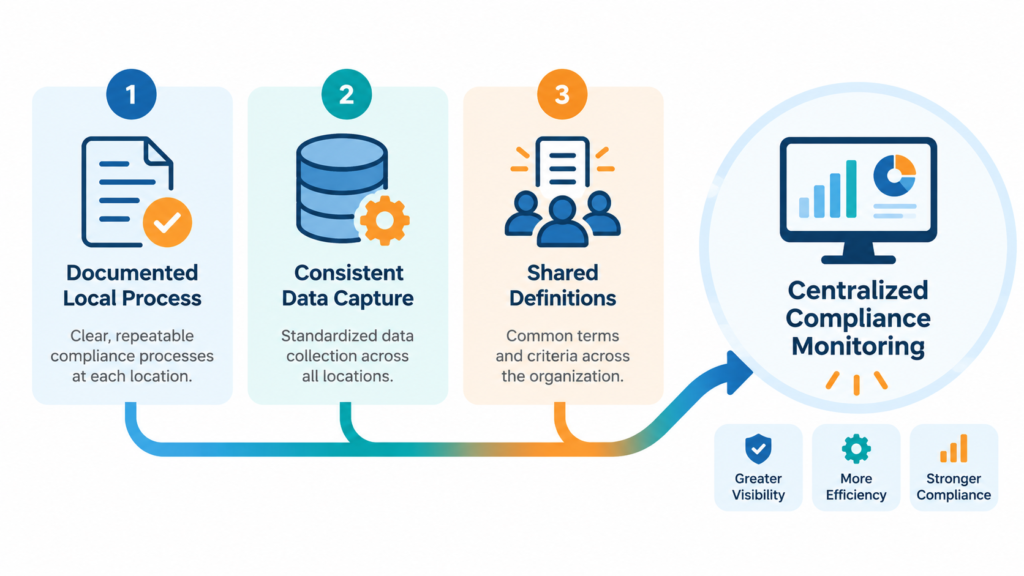
- Three conditions decide readiness: documented local processes, data captured consistently at the source, and agreement on what counts as a third party or an engagement.
- Immature local processes are the most common blocker, and the usual symptom is a central team writing rules for work it has never seen.
- Affiliate pushback is often a sign of a missed local requirement rather than a fight over control.
- A pilot on a messy category teaches more than a pilot on the best-run one.
Centralizing compliance monitoring is attractive for good reasons. The Department of Justice (DOJ) Evaluation of Corporate Compliance Programs asks whether compliance teams have timely access to the data they need for monitoring, and how companies manage third-party risk. Agencies, local consultants and healthcare professional (HCP) engagement channels such as speaker programs now draw scrutiny that used to fall on the company directly, while boards ask questions that take weeks to answer and the same activity gets reviewed three different ways in three countries.
So a central model gets proposed, a platform gets selected, and a few months in, the program stalls. The platform is rarely the cause, and affiliates usually aren’t either. More often, the conditions for centralizing were never in place and nobody checked beforehand.
Condition One: The Local Process Exists on Paper
Centralization standardizes a weak process and makes it visible, but it doesn’t fix it.
If a market has been running its monitoring informally, with judgment applied by two experienced people and very little written down, moving that market onto a central platform transfers the forms without the judgment. What arrives centrally is a thinner version of what happened locally, and the central team now owns an output it can’t interpret. Local teams then receive criteria that don’t match what they see, start flagging everything or nothing, and the data loses meaning in both directions.
Three questions show whether a market is ready:
- Is the current process written down anywhere other than in somebody’s head?
- If the person who runs it left tomorrow, could someone else follow it?
- When an exception is made, is there a record of who made it and why?
A market that can’t answer those should be documented before it’s centralized.
Condition Two: Capture Is Consistent at the Source
The second condition gets less attention and causes more damage. Central analysis depends on data captured consistently at the point of entry, and most organizations only discover their inconsistencies when they try to combine markets. Typical examples include one vendor entered under four spellings, engagement types picked from lists that differ by country, free-text fields where structured ones were needed, and dates in local formats. None of these look like problems inside one market, because everyone there knows what they mean.
Combined centrally, they produce a dataset nobody can query, and the central team spends its first year cleaning data instead of monitoring, which is the work centralization was supposed to remove.
Testing this is cheap. Take one engagement type, pull the records from three markets and try to count them consistently. If that takes more than an afternoon, fix capture first.
Condition Three: Everyone Agrees on Definitions
This one sounds simple, yet organizations often discover mid-program that their markets disagree on what counts as a third party, what counts as an engagement, and where a vendor ends and a partner begins. One market treats a distributor as a customer while another treats the same arrangement as an intermediary that needs due diligence. A speaker program run through an agency is logged as an agency contract in one place and an HCP engagement in another.
Until those definitions are agreed, a central risk score compares things that aren’t comparable. The disagreement usually surfaces late, when someone asks why one market shows four times the third-party population of a similar one.
Reading Affiliate Pushback Correctly
Some affiliate resistance really is about autonomy, and it gets most of the attention. The more useful kind is specific. When an affiliate objects to a central design by citing a local requirement, the objection is often correct, and it means the central team didn’t ask the right question early enough. The same tension shows up in cross-border HCP engagements, where local rules often decide what a central process has to allow.
Treating that pushback as resistance to change produces a program that ships on time and then gets worked around. Treating it as a design input slows the start and produces something that lasts. A simple filter helps: ask the affiliate to name the requirement the central model misses. An objection that resolves into a named rule is design feedback, and one that stays general is usually about control, which needs a different conversation.
Choose a Pilot That Can Fail
Most pilots pick a high-risk category because it seems to show the most value. For a readiness test, that logic runs backward. The high-risk category is usually the best-run part of the program, with attention, documented process and experienced people, so a successful pilot there only proves centralization works where things already work.
A messy category shows how much undocumented process, inconsistent data and disagreement over definitions you’re carrying, before any of it reaches the central model. If the three checks pass there, the rest will follow, and if they don’t, you’ve learned that cheaply. The same goes for market selection. Everyone proposes the mature market, but the more informative pilot is the one with a legacy tool and a long-serving local manager, because that’s where Condition One is most likely to fail.
What Good Sequencing Looks Like
Once those conditions are met, the order is fairly well understood. Agree definitions and fix capture at the source, bring the data together and confirm it can be queried, apply shared risk criteria and workflows, and only then add automated detection.
MonitorMate is built to follow that order rather than demand everything at once. Implementation starts with definitions: you bring the activity types your program covers, and we configure them in the platform along with the checklists and templates your reviewers use. A program still building its list can start from MonitorMate’s standard set of activity types and issue categories. Inside the platform, the Risk Assessment and Mitigation Plan (RAMP) comes first, and the monitoring plan and forms follow as separate steps shaped by what the assessment found. Findings from monitoring then move into remediation with automated workflows and notifications.
RAMP scores risk by activity type, which is why Condition Three matters. Two markets’ scores only compare once both mean the same thing by a speaker program or a grant. Half of each activity’s score is inherent risk, drawn from surveys of internal stakeholders, and half is control effectiveness, assessed by the local compliance officer. Because neither the business nor the compliance function sets the score alone, a market that answered the survey loosely still has a second view that checks it. The survey asks about the activities where exposure actually sits, such as speaker programs, grants, sponsorships and interactions with third parties, so each market’s plan follows its own risk profile.
For readiness, the point is that each step produces something usable on its own, so the program shows value early instead of only at the end.
To see how a RAMP assessment feeds a monitoring plan across several markets, book a MonitorMate demo.
Frequently Asked Questions
How long should documentation take before we centralize?
Usually less than teams expect. The goal is a written process that someone else could follow, not a validated standard operating procedure (SOP), and the exercise itself tends to surface most of the disagreements over definitions.
Can we centralize some markets and not others?
Yes, and phased rollouts by region are common where regulations vary a lot. What works badly is centralizing some processes but not others within the same market, because that leaves two systems of record and nobody trusts either one.
What if leadership wants this done quickly regardless?
Centralize the layers that don’t depend on local maturity first, which usually means data aggregation and reporting. Leave risk scoring and workflows until capture is consistent, since a partial central model people actually use is worth more than a complete one they avoid.
How do we know it’s working?
A good early test is whether you can compare one engagement type across two markets without raising a data request. If that still takes a week, the problem sits upstream of the platform.