Global Transparency Reporting Governance: Which Layers Belong Where
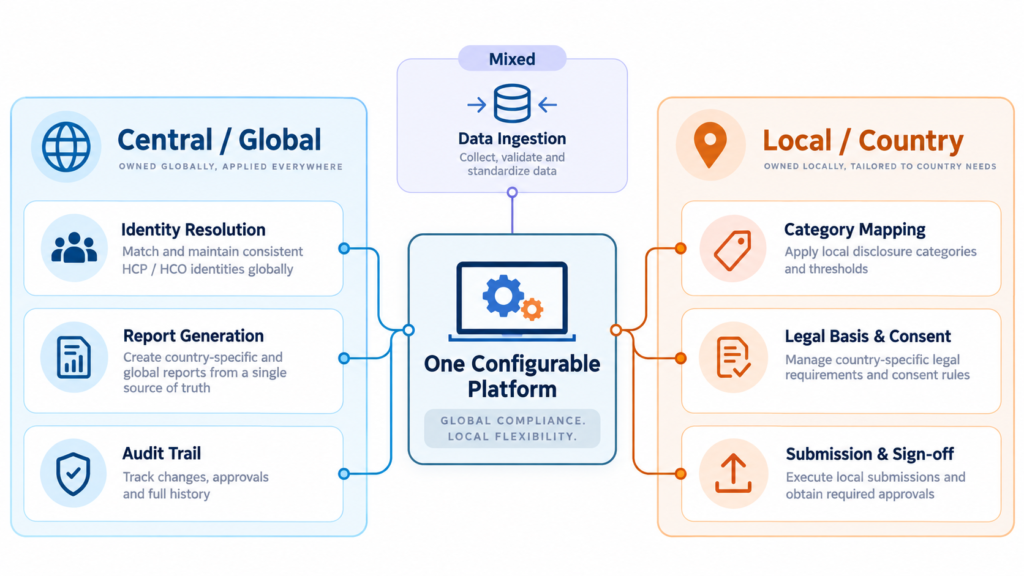
Global or local is the wrong question for transparency reporting. The right answer is one platform, with each layer owned by whoever is actually in a position to get it right.
Key takeaways
- Transparency reporting is not one process. It is seven, and ownership differs by layer.
- Identity resolution belongs centrally because it needs external reference data no affiliate maintains.
- Category mapping belongs to the country, since both the categories and the reportable recipient types differ by market and by report type.
- Legal basis and consent cannot be centralized. Local law decides them, and consent is collected at contracting.
- Separate local systems cannot give you comparability. A rigid global template forces markets into categories that do not fit.
Most organizations arrive at this question the same way. Disclosure obligations have spread into more markets, each with its own thresholds and formats, and the annual cycle has turned into a reconciliation exercise that eats a quarter. Somebody proposes centralizing it. Affiliates object that head office does not understand local rules. The proposal shrinks to a data warehouse and nothing else changes.
The affiliates are right about some of it and wrong about the rest. Separating the two is the whole exercise, and it is why the choice is not between one global system and fifteen local ones. It is between one system configured per layer and everything else.
The seven layers
| Layer | Belongs | Why |
| Data ingestion | Mixed | The output layout is standardized, the source systems and rules are not |
| Identity resolution | Central | Needs external reference data no affiliate maintains |
| Category mapping | Local | Categories and recipient types differ by country and report type |
| Legal basis and consent | Local | Local law decides, and consent is collected at contracting |
| Report generation | Central | Mechanical once the configuration above is set |
| Submission and sign-off | Local where the filing entity is local | The obligation sits with the local legal entity |
| Audit trail | Central | One record, retrievable years later |
Three of those are worth arguing about.
Ingestion is not purely technical
Ingestion is the layer most often described as plumbing, and that description does it a disservice.
The transformed output needs to be standardized, because nothing downstream works otherwise. What feeds it varies. Source systems differ by market, the rules applied during ingestion differ, and so does the decision about what to bring in at all. A market running a local events agency and a different expense platform is not doing the same ingestion as one that sits entirely on the global stack.
Identity resolution is central by necessity
This is the layer most programs get wrong. A physician engaged in two markets appears in two affiliate systems under two slightly different records. Resolved locally, they stay two people. Resolved centrally against maintained external reference data, they become one, and their cumulative annual value becomes visible for the first time.
SpendMate matches customer profiles against Veeva Open Data and other reference vendors, and matches automatically where a unique identifier such as an NPI number or a local equivalent exists. No affiliate maintains reference data of that kind, which is what makes this layer central by necessity rather than by preference.
Category mapping belongs to the country
This is where a global template does the most damage.
Which category a given payment falls into inside the disclosure report is configured per market, because the categories themselves differ by country and by report type. So do the reportable recipient types. Nurses are reportable in some European markets and not in others, which is not a detail a central team can reason its way to from a policy document.
In SpendMate those mappings are configured from the interface at country level, by the people who know what their market requires. The practical point for anyone designing a model is that they are not a global constant, and treating them as one is how the over-centralized failure starts.
Legal basis cannot move at all
Whether an individual disclosure is permitted, and on what legal basis, is a question of local law and local interpretation. Where consent is the basis, it is collected at contracting, by the people setting up the engagement. No central function can retrofit it later.
Any plan that ignores this produces reports the local entity cannot lawfully file.
The two ways this fails
Over-centralized. Reports come out technically consistent and locally wrong. Categories that make sense globally do not match how a market defines them. The affiliate spots the problem, has no way to change it, and starts keeping a corrected spreadsheet alongside the platform. Within two cycles you have the fragmentation you centralized to remove, plus a platform nobody trusts.
Under-centralized. Each market’s report is defensible on its own and none of them are comparable. Year-over-year trends cannot be built. The same physician appears three times. This matters more than it used to, because regulators and journalists now compare disclosures across companies and across years, which is exactly the view your own data cannot produce.
The second failure is more common and harder to see, since nothing breaks until someone asks a question spanning two markets.
This is the argument for a single configurable platform rather than for centralization as such. One system can hold a central identity layer and a country-configured mapping layer at the same time. Fifteen local systems cannot produce a comparable view. One rigid global system cannot accommodate a market where nurses are reportable and the neighboring market where they are not.
Where the quality actually comes from
Most of what determines report quality happens long before the reporting cycle starts. If an engagement is categorized inconsistently when it is approved, it arrives in the disclosure categorized inconsistently, and by then nobody remembers why. Spend data flowing from EngageMate into SpendMate carries whatever quality it had at approval. Fixing the reporting layer improves consistency. It does not fix upstream capture, and teams that expect it to are usually disappointed.
Exceptions and corrections are worth tracking as a program metric rather than as cycle noise. Where those findings run through MonitorMate, an issue found in one cycle can change what gets checked in the next.
How to sequence it
Take the layers in the order above rather than all at once. Ingestion and identity resolution come first, because they change what the organization can see without requiring anyone to work differently. Country mapping configuration follows, with affiliates setting their own market’s categories and recipient types rather than receiving them.
Consent is the exception to that order. It is collected at contracting, before any of this runs, so the task is not to schedule it but to make sure what is collected at contracting actually reaches the reporting layer. Submission can stay local until the rest is stable.
A useful test before starting. Pick one physician engaged in three markets and try to produce their total annual value across all three. How long that takes, and how confident you are in the answer, tells you which layer to fix first.
Frequently asked questions
Does one platform mean affiliates lose control?
No. Mapping categories, recipient types, legal basis, and local rule interpretation all stay with them. What centralizes is the data layer underneath, which is infrastructure rather than judgment.
What if local rules conflict with our global policy?
Local rules win, and the system has to accommodate that rather than override it. This is the main reason configurability matters more than a fixed global template.
We already have a data warehouse. Is that centralization?
It is one layer of it. A warehouse puts the data in one place. It does not resolve identities, hold country-level mapping configuration, or give you an audit trail tying a submitted figure back to its source.
How do we know our current split is wrong?
Two symptoms. Affiliates maintaining their own spreadsheets alongside the platform points at a model that is too rigid. An inability to answer a question spanning two markets points at the opposite.
Find out where your split sits
Send us the layers as you run them today, from ingestion through to submission, and which sit globally and which sit locally. We will tell you where the boundaries are in the wrong place and which layer would give you the most back if you moved it.
Contact us to arrange it.