A Practical Compliance Model for Small Biotech Companies With Lean Resources
Small biotech companies often operate for years without a full time compliance department. That does not mean compliance can be ignored, and it does not mean the company needs to recreate a large pharmaceutical compliance function overnight.
The practical approach is usually a phased one: assign clear ownership, establish a small set of non-negotiable controls, bring in fractional or consulting expertise where internal knowledge or capacity is limited, and add right-sized technology as transaction volume and regulatory obligations make manual processes unreliable.
Although this article focuses on small biotech companies, many of the same challenges apply to smaller pharmaceutical and medical device organizations operating with lean compliance resources. The underlying issue is often the same: the business is growing faster than the structure used to manage compliance.
The goal is not to build the biggest compliance program. It is to build the right foundation early enough that commercial launch, HCP activity, investor diligence, transparency reporting, or geographic expansion does not force the company into a costly reconstruction exercise.
Quick answer: A small biotech can manage compliance without a dedicated team by naming an accountable owner, using fractional compliance support, standardizing HCP engagement and spend data, documenting core policies and training, and adopting modular technology before manual tracking becomes unreliable.
Why Small Biotech Companies Eventually Outgrow Informal Compliance
The moment that forces a small biotech to formalize compliance is rarely a regulator arriving at the door.
In Cresen’s experience, the trigger is more often operational: the company is preparing for commercial launch, HCP engagements are becoming frequent, an investor or strategic partner asks to review the compliance program, or a first transparency reporting deadline is approaching.
These moments expose a problem that may have been building quietly.
The company has policies, emails, expense records, approvals, and engagement documents, but they are not organized as one defensible process. Someone may be able to answer an individual question, yet the business cannot reliably show how decisions were approved, how spend was captured, what risks were identified, or whether corrective actions were completed.
Which Compliance Process Usually Breaks First?
For many lean biotech companies, spend and HCP engagement tracking become difficult first.
Meals, speaker programs, advisory activities, and fee for service payments can create transaction volume quickly. The underlying information often sits inside expense, finance, contracting, and email systems that were never configured with compliance monitoring or transparency reporting in mind.
At the same time, documentation and approval workflows may begin to degrade quietly.
Engagements are approved after commitments are made. Supporting documents are stored in different folders. Required fields are entered inconsistently. The problem may remain invisible until an investor, auditor, partner, or reporting team asks for a complete audit trail.
This is why early compliance work should focus as much on data capture and ownership as it does on policies.
A policy can be written later. Transaction data that was never captured consistently is much harder to reconstruct.
Who Owns Compliance When There Is No Compliance Team?
Before a dedicated function exists, compliance is commonly assigned to the General Counsel, CFO, Head of Regulatory, an operations leader, or occasionally the CEO.
The problem is usually not competence. It is bandwidth and level of attention.
A part-time owner may be able to approve a policy, answer a diligence question, or respond to an urgent concern. That same person may not have the capacity to review transactions regularly, test whether controls are working, track remediation to closure, or identify a pattern developing across multiple quarters.
Without a defined operating model, compliance becomes reactive and event driven. The company responds when something happens instead of continuously capturing, reviewing, and learning from the activity already taking place.
A Practical Compliance Model for a Lean Biotech
The most realistic model is not simply “hire a person,” “hire a consultant,” or “buy software.”
Small biotech compliance usually develops through a combination of all three, introduced at different stages.
At Cresen, our view is that lean compliance should scale in stages. A small or emerging company should not try to recreate a large enterprise compliance function on day one. It should put the right controls in place for its current level of risk and build a foundation that can expand as commercial activity, reporting obligations, and organizational complexity increase.
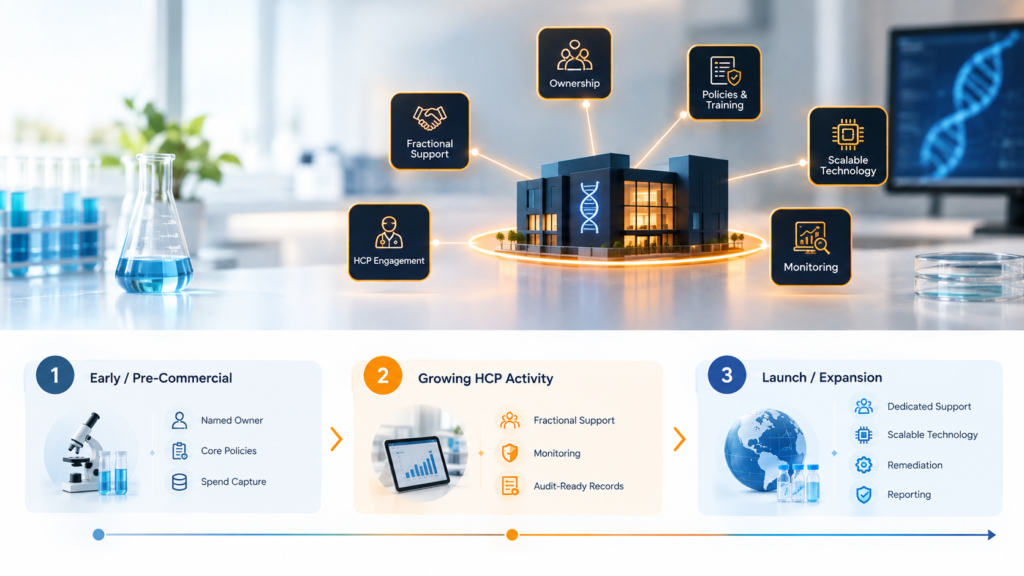
Early or Pre-Commercial with Limited External Activity
Right-sized approach:
A named internal owner supported by targeted outside expertise.
Immediate priorities:
- Core policies
- Documented training
- Approval rules
- Consistent spend capture
- A clear escalation process
Growing HCP Activity or Investor and Partner Diligence
Right-sized approach:
Fractional compliance support combined with standardized workflows and data.
Immediate priorities:
- HCP engagement controls
- A practical monitoring plan
- Consistent documentation
- Audit ready records
- Defined process ownership
Commercial Launch, First Transparency Obligation, or Multi-Country Expansion
Right-sized approach:
Dedicated headcount or managed support combined with scalable technology.
Immediate priorities:
- Repeatable workflows
- Monitoring
- Issue management
- Reporting
- Remediation tracking
- Clear accountability
This phased approach prevents two common mistakes: waiting until the company is already under pressure or buying an enterprise scale system before the organization has defined what it actually needs to control.
Consultant, Software, or Internal Hire: How Should a Small Biotech Decide?
The decision is not necessarily one or the other. Each option solves a different part of the problem.
Use Fractional or Consulting Support to Establish the Framework
Outside expertise is most valuable when the company needs to translate broad compliance expectations into a practical operating model.
A consultant or fractional resource can help define ownership, assess risk, develop core policies, establish approval and escalation workflows, design monitoring, and prepare the organization for launch or diligence.
This can give the company access to specialized knowledge without immediately building a complete internal department.
Add Software When Manual Tracking Stops Being Reliable
Technology becomes necessary when the number of engagements, transactions, markets, reviewers, or remediation items makes spreadsheet based tracking difficult to maintain.
The trigger is not a specific employee count or revenue figure. It is the point at which the company cannot answer basic compliance questions quickly and consistently without a manual reconstruction exercise.
For example:
- Can the company identify how many HCP engagements occurred last quarter?
- Can it show who approved each engagement?
- Can it retrieve supporting documentation easily?
- Can it identify repeated activity or unusual spend?
- Can it show whether identified issues were remediated and closed?
When answering those questions requires multiple people, systems, emails, and spreadsheets, the informal approach is becoming unreliable.
Build Internal Headcount as Compliance Becomes Continuous Work
Dedicated headcount becomes more important around commercial launch, meaningful HCP engagement volume, recurring transparency obligations, or multi-country expansion.
At that stage, compliance is no longer an occasional project. It is a continuing operating responsibility that needs day to day ownership.
The internal compliance leader can then coordinate business stakeholders, external advisors, monitoring activities, technology, investigations, reporting, and remediation.
Five Compliance Basics Every Small Biotech Should Put in Place
Even when software or dedicated headcount is not yet affordable, five foundations should not be postponed.
- Name One Accountable Owner
The role may be part-time, but responsibility should be explicit.
Employees need to know who approves activities, answers questions, receives escalations, and coordinates outside support. Shared responsibility without a named owner often becomes no responsibility at all.
- Require Approval Before HCP Commitments Are Made
A documented pre-approval step is more valuable than trying to correct an engagement after the company has already committed funds or services.
The workflow can begin simply, but it should establish:
- What requires approval
- Who reviews it
- What documentation is required
- When approval must be completed
- How exceptions are handled
- Capture Spend in a Consistent Structure from Day One
Define required fields, categories, owners, and supporting documentation before transaction volume grows.
The company should determine what must be captured for activities such as:
- Meals
- Speaker programs
- Advisory boards
- Fee-for-service arrangements
- Travel
- Grants or sponsorships
- Other transfers of value
Consistency matters more than sophistication at the beginning.
- Create a Short Set of Core Policies and Document Training
A lean company does not need hundreds of SOPs. It needs practical guidance covering the activities it actually performs.
Employees should understand the rules that apply to their responsibilities, and the company should retain evidence that relevant individuals received and completed the required training.
- Establish a Simple Escalation Path
People need a clear process for raising concerns, resolving exceptions, documenting decisions, and escalating issues that require Legal, Regulatory, Finance, HR, or leadership involvement.
The common theme is capture and ownership.
Sophisticated analytics can come later. Missing data and undocumented decisions are much harder to repair after the fact.
Is a Spreadsheet Enough for Small Biotech Compliance?
A spreadsheet is not automatically a bad tool.
For a very early company with low activity, a well designed spreadsheet with named ownership and regular review may be a reasonable starting point.
The weakness appears as risk begins to cluster.
The pattern that matters may be the same employee, HCP, speaker, transaction type, geography, or policy exception appearing repeatedly over several quarters. A spreadsheet reviewed occasionally by a part-time owner is not designed to surface those patterns reliably or route them into a structured remediation process.
The question is therefore not whether spreadsheets look professional. It is whether the current process can consistently answer:
- Who approved the activity, and when?
- Was all required documentation collected before payment?
- Can the company identify repeated activity or unusual spend patterns?
- Are issues assigned to an owner and tracked through closure?
- Can the company produce a clear record for an audit, investor, partner, or reporting deadline without weeks of reconstruction?
If the answer to several of these questions is no, the company has probably outgrown its spreadsheet-based approach.
A Composite Example: The Cost of Data That Was Never Captured
Consider a composite example based on situations Cresen has encountered.
A growing life sciences company wanted to build a comprehensive compliance analytics dashboard using years of expense data. The business expected the dashboard to show patterns across HCP activity, spend, and monitoring indicators.
During the feasibility assessment, only a fraction of the planned views could be built.
The transactions existed, but essential fields had been entered inconsistently or were missing altogether because the original expense process had never been designed with compliance monitoring in mind.
The solution was not to create a more complicated dashboard.
It was to fix the process upstream: standardize what had to be captured at the point of entry, define ownership for data quality, and then build monitoring and analytics on top of reliable information.
The lesson for a small biotech is straightforward: the cost of informal compliance often appears later as data the organization cannot use.
Audit preparation may take weeks of reconstruction instead of days of retrieving existing records. Remediation may live in email chains rather than being assigned, documented, and tracked to closure.
Signs a Small Biotech Has Outgrown Its Informal Approach
A company should not wait for a failed audit or regulatory finding to decide that its process is no longer working.
More practical warning signs usually appear earlier:
- HCP engagements or payments are being approved after the activity has already been committed.
- No one can state how many HCP engagements occurred last quarter without an ad hoc data exercise.
- Investor, partner, audit, or diligence requests take weeks to answer.
- Spend categories and supporting documentation are inconsistent across employees or systems.
- Monitoring findings and corrective actions are tracked through email or separate spreadsheets.
- The same exceptions or questions keep recurring, but the company cannot see the trend clearly.
- The business is entering new countries or preparing for launch without a repeatable compliance operating model.
Any one of these signs should prompt the company to review whether its current compliance process can support the next stage of growth.
What Should the Company Do 6–12 Months Before Launch or Expansion?
The most useful preparation is often unglamorous: standardize ownership and data capture before the next stage of growth forces the issue.
Six to twelve months before commercial launch, meaningful HCP expansion, a transparency reporting obligation, or entry into additional countries, a small biotech should:
- Complete a focused compliance risk assessment based on planned commercial activities.
- Define who owns each core compliance process and who serves as backup.
- Standardize HCP engagement, approval, contracting, documentation, and spend fields.
- Create a practical monitoring plan tied to the company’s highest-risk activities.
- Set up an issue and remediation process with owners, due dates, evidence, and closure criteria.
- Test whether the company can answer a sample audit or diligence request using existing records.
- Decide which work belongs internally, which should be supported through fractional expertise, and which workflows need technology.
Retrofitting structure onto historical data is usually the slower and more expensive version.
Preparing early gives the organization time to build processes that employees can actually follow.
How Cresen Supports Right-Sized Compliance for Small Biotech Companies
Cresen’s approach is not to force a small biotech into an enterprise-sized compliance footprint.
Our view is that smaller life sciences organizations should start with the controls and capabilities they genuinely need today, while making sure those processes can scale as the company grows.
That often means starting with consulting or fractional support to establish the compliance framework first.
Cresen’s consulting and managed support can help a lean team with:
- Program maturity assessment
- Compliance process design
- Risk assessment
- Policy and training support
- Monitoring design
- Implementation planning
- Ongoing operational guidance
Once the framework is in place and transaction volume increases, technology can support the areas where manual oversight becomes difficult.
MonitorMate can be introduced in a modular way rather than requiring a company to adopt a large enterprise footprint from the beginning.
A company may start with focused capabilities such as:
- Risk assessment
- Monitoring
- Issue management
- Remediation tracking
- Dashboards
Additional capabilities can be added as the compliance program becomes more mature and business activity expands.
This phased model is particularly useful for smaller organizations because it connects compliance investment to actual operational need.
The objective is not simply to deploy software. It is to create a sustainable compliance operation in which ownership, data, workflows, monitoring, issue management, and remediation reinforce one another.
Why the Same Approach Can Apply Beyond Biotech
Although small biotech companies are the primary focus of this discussion, similar issues can arise in smaller pharmaceutical and medical device organizations.
A lean medical device or pharmaceutical company may also have:
- Limited dedicated compliance headcount
- Growing interactions with healthcare professionals or organizations
- Increasing commercial activity
- New reporting obligations
- Multiple markets or business units
- Manual approval and documentation processes
- Investor, partner, or audit requests that expose gaps in historical data
The specific compliance obligations and risk areas may differ by organization, product, and market, but the operating principle remains similar: establish ownership early, capture reliable data, document decisions, monitor the highest-risk activities, and introduce scalable support before complexity overwhelms the informal process.
The Bottom Line
Small biotech companies can manage compliance without a dedicated team, but they cannot manage it effectively without ownership and structure.
A lean, defensible model starts with:
- A named owner
- Clear HCP approval rules
- Consistent spend capture
- Core policies and documented training
- A simple escalation process
Fractional expertise can establish the framework. Right-sized technology can make the process more reliable as volume grows. Dedicated internal headcount becomes necessary when launch, reporting, expansion, and daily monitoring turn compliance into continuous work.
At Cresen, our perspective is that the strongest small-company compliance programs are built in stages. They do not try to replicate the complexity of a large enterprise on day one, but they also do not wait until launch, reporting, diligence, or an audit exposes structural gaps.
The best time to formalize the process is before the company discovers that years of historical data cannot support an audit, monitoring program, or business decision.
It is six to twelve months before the next stage of growth makes that structure unavoidable.
Build a Compliance Program That Fits Your Company Today and Scales for Tomorrow
Cresen Solutions can help emerging life sciences organizations establish practical compliance ownership, workflows, monitoring, and modular technology without adding unnecessary complexity.
Contact Cresen Solutions to discuss a right-sized approach for your current stage and future growth plans.
Frequently Asked Questions
Can a Small Biotech Operate Without a Full-Time Compliance Officer?
Yes, particularly at an early stage, but compliance responsibility must still be clearly assigned.
A named internal owner should be supported by practical controls and, where needed, fractional expertise. The model should expand as commercial activity, reporting obligations, and geographic reach increase.
Who Usually Owns Compliance at a Small Biotech?
The responsibility often sits with the General Counsel, CFO, Regulatory, Operations, or the CEO before a dedicated function exists.
The key risk is not that these leaders lack capability. It is that compliance may receive attention only when an urgent event occurs.
When Should a Small Biotech Hire a Dedicated Compliance Professional?
There is no universal headcount or revenue threshold.
Strong triggers include commercial launch, meaningful HCP engagement volume, a first transparency reporting obligation, recurring monitoring work, investor or partner diligence, and multi-country expansion.
Is a Spreadsheet Sufficient for Biotech Compliance?
A spreadsheet may work temporarily for a low-volume company with clear ownership and disciplined review.
It becomes unreliable when activity increases, multiple systems are involved, or the company needs to identify recurring patterns, manage remediation, and produce audit-ready records quickly.
What Should a Small Biotech Prioritize Before Commercial Launch?
Priorities should include a focused risk assessment, defined process ownership, HCP engagement and spend controls, core policies and training, a monitoring plan, an escalation process, and a method for tracking issues and remediation to closure.
Do These Principles Apply to Small Pharma and Medical Device Companies Too?
In many cases, yes.
The exact risks and regulatory obligations may differ, but smaller pharmaceutical and medical device organizations often face the same operational challenge of managing growing compliance responsibilities with limited internal resources. A phased model built around clear ownership, reliable data, practical controls, and scalable support can apply across emerging life sciences organizations.