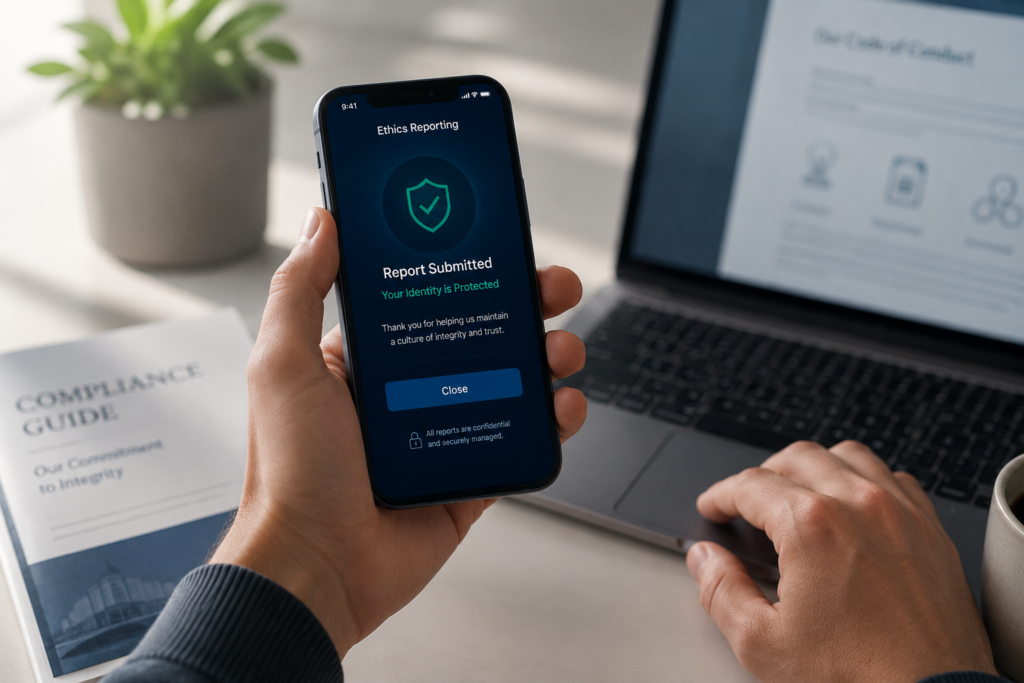
Ethics Hotline Management for Life Sciences Compliance
Many leaders feel unsettled right now. Whistleblower stories are in the news, transparency requirements keep expanding, and audit teams are asking harder questions. The instinct is to look at the ethics hotline and hope it will hold up when pressure hits.
Here is the reality: the hotline itself is rarely the problem. The trouble lives in the strategy around it – how it is structured, promoted, and connected to the rest of the compliance program. When a hotline is treated as a box to tick rather than a genuine integrity tool, trust erodes, risk quietly grows, and cultural warning signs stay hidden until they cannot be ignored. Ethics hotline management has become a critical part of modern compliance programs in life sciences and healthcare organizations.
For life sciences and healthcare organizations, the stakes are especially specific. The OIG’s seven elements of an effective compliance program have long called for accessible reporting channels and documented case resolution. The False Claims Act and DOJ guidance on corporate compliance programs make a well-functioning hotline a credibility factor in any enforcement scenario not simply a best practice. When regulators or qui tam relators arrive, the first question is rarely whether a hotline existed. It is whether employees genuinely trusted it, and whether leadership consistently acted on what came through.
This article walks through where programs most commonly break down, what a modern approach looks like in practice, and how EthosLine – Cresen’s purpose-built hotline and case management solution helps life sciences teams close those gaps.
The Myth of “We Have a Hotline, So We Are Covered”
Many organizations launched a hotline years ago and have not revisited it since. It might still be a single phone number on a break room poster, or a basic web form buried in an intranet. On paper, it checks a compliance box. In practice, expectations around transparency, ethics, and reporting have moved on considerably.
This checkbox mindset tends to overlook a few critical realities:
- Regulations and reporting obligations keep evolving across every region in which global organizations operate.
- Stakeholders including boards, investors, and employees expect far more than bare-minimum reporting channels.
- Regulators want to see evidence that people actually use the hotline, not just that one exists.
Relying on a single channel also ignores the very real differences in how people prefer to report. Some employees are more comfortable with a web form than a phone call. Others need native language support, time-zone-appropriate availability, or reassurance that third parties are permitted to report. Global field teams and commercial partners may not even know the hotline is available to them.
Then there is the trust problem, which may be the most significant barrier of all. When people fear retaliation, question whether their anonymity is genuinely protected, or feel uncertain about where reports actually go, they choose silence. Sometimes they bypass internal channels entirely and go directly to regulators, media, or social platforms. At that point, the narrative is already out of the organization’s hands.
A note on true anonymity: Modern intake should meet reporters where they are web form, phone line, mobile app, QR code, email, or SMS. But each channel must be genuinely anonymous, not just technically anonymous. That means no IP logging, no mandatory employee ID fields, and plain-language communication about how anonymity is protected under local law. Equally important is two-way anonymous dialogue: the ability for investigators to ask follow-up questions and for reporters to track whether action has been taken, without ever surfacing their identity. Without this, cases stall and trust continues to erode.
Where Case Management Breaks Down After a Report Is Filed
Even when someone summons the courage to speak up, that is only the beginning. Many programs unravel in what happens next. A significant number of compliance teams still manage ethics cases through email chains, shared folders, or general IT ticket tools, systems that were never designed for sensitive, regulated matters.
When case handling depends on patchwork tools, predictable problems emerge:
- Critical details disappear in long email threads with no single record of truth.
- Evidence and attachments sit in unsecured folders accessible to people who should not see them.
- Deadlines slip because no one has visibility into the full queue or individual case status.
Without risk-based intake and routing, every report looks the same regardless of severity. A minor workplace concern can consume urgent investigator time while a serious patient safety or product quality issue sits unaddressed. That misalignment creates the kind of legal, financial, and reputational exposure that is very difficult to explain to a board or regulator after the fact.
There is also a missed learning loop. If the system does not capture structured data, timelines, and outcomes, leadership cannot answer foundational questions: Where are our most persistent issues? Which regions need targeted training? Are retaliation claims trending upward? Without reliable dashboards and analytics, decisions are based on instinct rather than evidence.
The investigator experience is another dimension that rarely receives enough attention. When the team handling cases lacks proper tooling – task assignment, SLA tracking, interview documentation, conflict-of-interest flags, and audit-ready evidence chains, investigation quality and timeliness suffer. Role-based access controls are equally important: a case in one region should not be visible to colleagues who have a potential conflict of interest. Without these guardrails built into the platform, even a well intentioned team creates unintended exposure with every sensitive matter they handle.
How Global Complexity Quietly Undermines Even Good Programs
For organizations operating across multiple countries, the compliance environment is layered and jurisdiction-specific. Rules around privacy, labor protections, and reporting obligations differ meaningfully from one country to the next. Some jurisdictions limit what categories of misconduct can be reported, how long case data may be retained, or who within an organization may access investigation records. When hotline data flows through disconnected tools and inboxes, it is surprisingly easy to create a compliance issue while trying to prevent one.
Vendor sprawl compounds the problem. When different regions or business units select their own hotline providers or build their own ad-hoc processes, the result is fragmentation:
- Intake forms and reporting categories differ across geographies.
- Investigation standards and documentation practices vary by site.
- Different reports reach leadership with no common framework for comparison.
This fragmentation makes it nearly impossible to see the full organizational risk picture or demonstrate a consistent ethics standard to regulators asking how issues are managed globally. The answer to fragmentation is a centralized, scalable approach that provides one standard for intake, language support, and case handling while still respecting local legal requirements. Done well, this kind of global program supports local teams rather than constraining them, and creates a single source of truth for ethics and compliance activity across the organization.
What a Modern Hotline and Case Management Program Looks Like
A modern program starts with smarter intake and triage. Not keyword matching, but structured intelligence: assigning an initial severity score based on allegation type, reporter identity- employee, contractor, or third party and region specific risk weight. It means auto classifying reports into defined categories at the point of intake:
| EthosLine Classification Categories at Intake
– Fraud, bribery, and financial misconduct – Retaliation and workplace conduct concerns – Product safety and quality signals – HCP interactions and commercial compliance – Data privacy and confidentiality – Conflicts of interest and gifts / entertainment |
When reports are structured from the start, investigators begin with context rather than a blank page. AI-assisted triage also surfaces potential connections between new reports and existing open cases, so patterns emerge early rather than only after they have become a pattern that regulators notice first.
For pharmaceutical and medical device organizations in particular, the ability to link an ethics report to a potential product quality or patient safety signal is not a feature, it is the kind of early warning connection that can prevent an adverse event, a regulatory action, or a public incident. This is where integrated compliance intelligence becomes genuinely valuable.
A strong program also uses a unified platform for the full case lifecycle. That means one place to:
- Receive reports across all intake channels and languages.
- Track every action, note, and decision from intake through closure.
- Store evidence securely with granular, auditable access controls.
- Manage investigator tasks and SLAs with clear ownership and escalation paths.
- Link root cause findings to follow-up training, policy updates, or control changes.
With this level of visibility, internal audit teams and external regulators see a clear, defensible record: what was reported, what was done, and when. No scrambling through email threads when an examiner asks for documentation.
Culture and communication matter as much as the technology. People need to hear consistently, from multiple voices and through multiple channels, that speaking up is not only permitted, it is expected. That retaliation has real consequences. That reports are reviewed seriously, and outcomes are communicated where legally possible. Simple, repeated messages from senior leaders, people managers, and HR can shift the hotline from something that feels risky to something that feels like a normal and respected part of doing the right thing.
Turning Your Hotline Into a Strategic Integrity Engine
Viewed through the right lens, a hotline is not a compliance obligation. It is an early warning system for the entire organization. Reports surface fraud risks, quality gaps, patient safety concerns, and cultural stress points long before they appear in public or on a regulator’s radar. The data from a well-run hotline and case management program can guide smarter investment decisions around controls, training, and resources and demonstrate a proactive compliance posture to every stakeholder who needs to see it.
The practical path forward begins with an honest assessment: How is the current program actually performing? Where are tools and processes disconnected? Are reporters genuinely choosing to use internal channels? Is there a clear, consistent analytics story that leadership can draw on?
EthosLine brings these elements together in a single platform built specifically for life sciences and healthcare combining multi-channel, genuinely anonymous intake; AI-assisted severity scoring and case classification; structured investigation workflows with SLA management and role-based access; and real-time reporting dashboards that give compliance leadership the visibility they need before the next review. And because EthosLine sits alongside MonitorMate for Live, Transactional monitoring and Quality 360 for quality and safety event management within the Cresen platform, teams can finally connect the dots across ethics, commercial, and quality risk in one unified compliance intelligence view.
At Cresen Solutions, we work closely with every client to configure workflows, reporting, and integrations to their specific regulatory and cultural environment. The goal is not a one-size-fits-all product, it is a program that actually works for your organization and holds up under scrutiny.
| Strengthen Your Culture With Trusted Reporting
Protect your organization and your people with a proven approach to intake, triage, and resolution of sensitive concerns. Our global ethics hotline management services are designed to give you clear visibility into integrity risk while making it easier and safer for employees to speak up. We work closely with you to tailor workflows, reporting, and integrations to your specific regulatory and cultural requirements. Ready to move forward with a more reliable ethics program? Contact us to discuss your goals and next steps. |