Compliance Risk Assessment in Life Sciences: Why Proactive Monitoring Matters
The Stakes
Compliance risk assessment in life sciences is no longer just a periodic exercise. Life sciences is one of the most enforcement heavy industries in the world. Pharmaceutical and biotech companies face layered regulations governing HCP interactions, promotional practices, clinical research, pricing, and financial transparency. When compliance fails, the consequences are measured in billions.
In fiscal year 2025, the DOJ reported $6.8 billion in False Claims Act settlements, the highest single year total in the statute’s history. Healthcare related violations accounted for over $5.7 billion of that figure [1]. Whistleblower filings hit a record 1,297 cases in the same period [1]. These are not abstract figures. They represent real enforcement actions against real companies that failed to identify and manage compliance risk before regulators did.
The DOJ has made its expectations explicit: prosecutors now evaluate whether organizations maintain risk based compliance programs that identify, assess, and mitigate operational risks before misconduct occurs [2]. The OIG echoes this, identifying risk assessment, monitoring, and auditing as core pillars of an effective compliance program for pharmaceutical manufacturers [3].
Where the Risk Lives
Compliance failures in life sciences rarely stem from deliberate fraud. They emerge from operational complexity, global scale, multiple regulatory jurisdictions, and the sheer volume of financial interactions with healthcare professionals.
HCP Interactions
Speaker programs, advisory boards, and consulting arrangements remain the highest-risk category. In April 2025, Gilead Sciences agreed to a $202 million settlement after the DOJ alleged its HIV speaker programs served as vehicles for improper inducements to prescribers [4]. The government cited lavish dinners, repeat attendees, and a lack of genuine educational content. This pattern where legitimate scientific exchange becomes indistinguishable from financial incentive is the core compliance challenge. Managing that risk across the full engagement lifecycle is its own discipline, covered in taking the risk out of your healthcare engagements.
Global Anti-Corruption
Companies operating internationally must navigate the FCPA and UK Bribery Act, particularly in markets where physicians are government employees. Third party intermediaries in these regions multiply the risk exponentially.
Transparency & Aggregate Spend
Published research has demonstrated that industry payments to physicians correlate with increased prescribing of promoted drugs [5]. Transparency reporting exists to keep these relationships visible. Gaps in tracking or reporting accuracy create both regulatory and reputational exposure. Our SpendMate white paper covers how reporting requirements differ by country and where tracking accuracy typically breaks down.
Promotional Compliance & Clinical Research
Off label promotion remains one of the most common enforcement triggers. Clinical trial payments and investigator relationships require strict independence to preserve scientific integrity and avoid FCA liability.
What Compliance Risk Assessment in Life Sciences Should Look Like
The DOJ’s September 2024 update to its Evaluation of Corporate Compliance Programs (ECCP) raised the bar. Prosecutors now assess whether companies use data analytics to continuously evaluate compliance effectiveness, whether AI and emerging technology risks are integrated into enterprise risk management, and whether reporting cultures are genuinely supported or chilled [2].
In practice, this means four things:
- Risk Identification. Systematically map exposure across commercial, medical, and research functions using operational data not assumptions.
- Risk Analysis. Score identified risks on likelihood and impact (financial, regulatory, reputational). Apply consistent methodology across business units and geographies.
- Risk Prioritization. Compliance resources are finite. Focus monitoring on the highest risk activities, not the easiest ones to measure.
- Risk Mitigation & Monitoring. Deploy targeted controls, updated policies, stronger approval workflows, focused training and monitor continuously. Annual reviews are no longer sufficient.
Cross functional collaboration is essential. Compliance teams that operate in isolation from legal, medical affairs, commercial, and finance will miss the operational realities that drive risk.
The Role of Data and Technology
Spreadsheets and manual reviews worked when companies were smaller and regulatory scrutiny was lighter. That era is over. The DOJ’s 2024 ECCP update explicitly asks whether companies leverage data analytics tools and whether compliance teams have sufficient resources and timely access to relevant data [2]. The expectation is clear: compliance must be continuous, integrated, and data-driven.
The challenge for most life sciences organizations isn’t a lack of data, it’s that the data lives in silos. T&E systems like Concur sit in one place. Vendor payments in another. HCP engagement records in a third. Internal audit findings in a fourth. When these systems don’t talk to each other, compliance teams are left chasing red flags after the fact instead of detecting patterns in real time. That fragmentation is the core limitation of legacy commercial compliance software.
MonitorMate: Closing the Loop
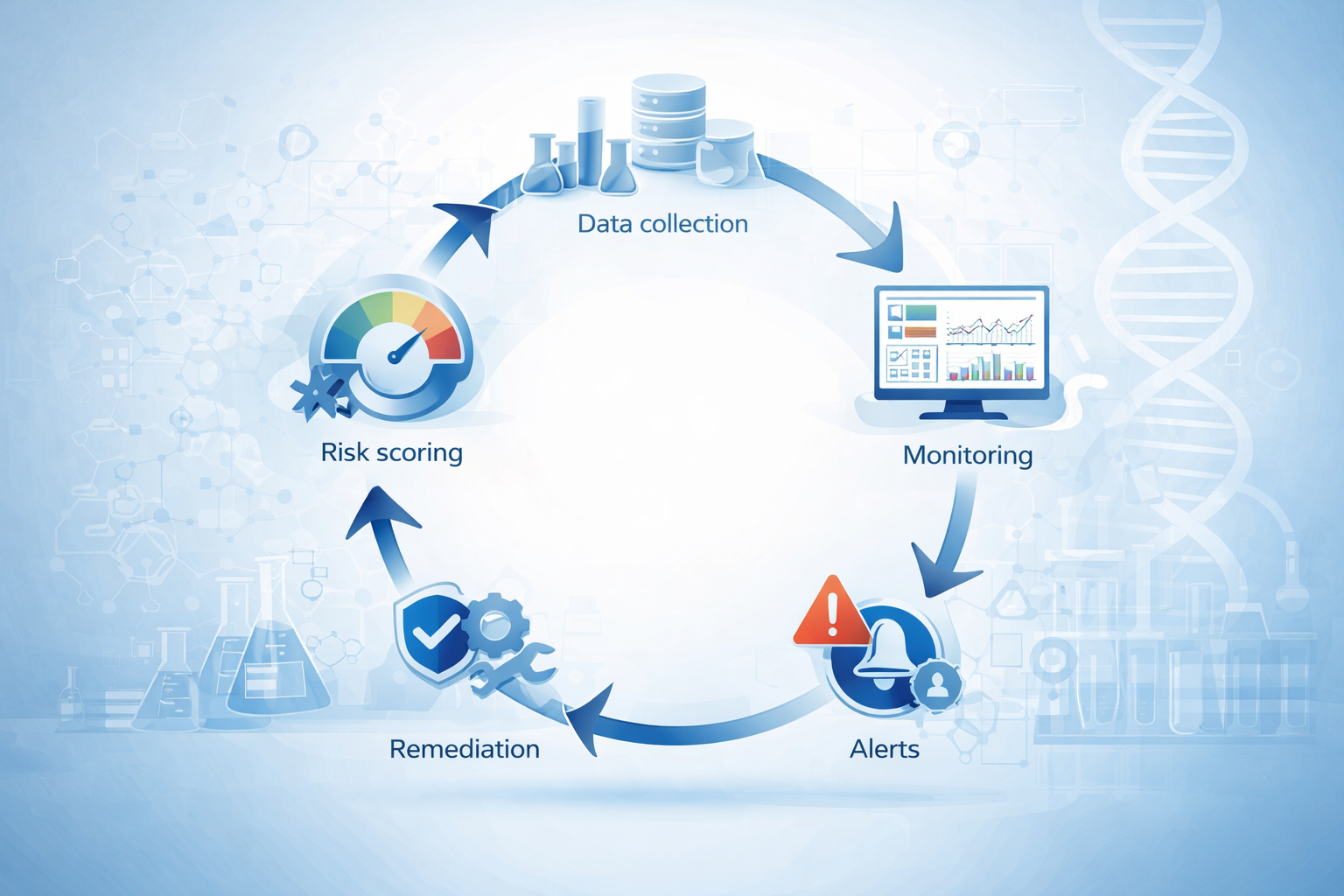
This is exactly what MonitorMate, Cresen Solutions’ monitoring and remediation platform, was built to solve. MonitorMate integrates directly with T&E platforms, vendor payment systems, and internal data sources, ingesting transactional data in real time.
It automatically detects compliance risks – meal threshold violations, high-frequency HCP engagements, vendor payment anomalies and maps each one to an individual employee or vendor for person-level risk profiling.
What sets MonitorMate apart is what happens after detection. Flagged issues are routed into a centralized remediation workflow where owners, due dates, corrective actions, and escalation paths are defined and tracked. Every action carries a full audit trail. Compliance teams aren’t just identifying problems, they’re closing them with documentation that holds up under regulatory scrutiny.
The platform also brings AI-driven risk scoring through its EZPredict 2.0 engine. EZPredict assigns weighted Key Risk Indicators (KRIs) — out-of-region travel, consecutive event days, meals in restricted states and calculates an overall risk score for each activity.
AI models then analyze the underlying data patterns and generate plain-language summaries of why a transaction was flagged as high-risk. That context is what allows compliance teams to make informed decisions instead of just chasing alerts.
Once risk-based samples are confirmed, Continuous Controls Monitoring (CCM) takes over. Using Natural language processing (NLP), Optical character recognition (OCR), and AI-driven decisioning, MonitorMate reads supporting documents, receipts, invoices, sign-in sheets and automates the transactional monitoring process.
Anomalies like missing signatures, duplicate receipts, or policy breaches get flagged instantly. The result: less manual work, shorter monitoring cycles, and more time for compliance teams to investigate the exceptions that actually matter.
For global pharmaceutical clients, the results speak for themselves: 80% reduction in manual remediation tracking, faster issue closure cycles, improved audit readiness, and critically the ability to use monitoring data to proactively shape the following year’s compliance plan. That’s the difference between a compliance program that reacts and one that prevents.
Bottom Line
Regulators are not asking whether you have a compliance program. They’re asking whether it works, whether it’s proactive, data driven, and capable of catching problems before they become $200 million settlements.
The companies getting this right connect risk identification to remediation in a single, auditable workflow. They’re not managing it across disconnected spreadsheets and email chains. Platforms like MonitorMate exist because the regulatory environment now demands that level of integration.
The organizations that invest in structured risk assessment, real time monitoring, and closed loop remediation are the ones that protect patients, preserve scientific integrity, and stay off the DOJ’s radar.
Sources
[1] DOJ: False Claims Act Settlements Exceed $6.8B in FY 2025 (Jan. 2026)
[2] DOJ: Evaluation of Corporate Compliance Programs (Updated Sept. 2024)
[3] HHS OIG: Compliance Program Guidance for Pharmaceutical Manufacturers
[4] DOJ: $202M Settlement with Gilead Sciences (Apr. 2025)
[5] DeJong et al., JAMA Internal Medicine (2016): Industry Meals and Prescribing Patterns