

What to Look for in Transparency Reporting Software Across Markets
Key Takeaways
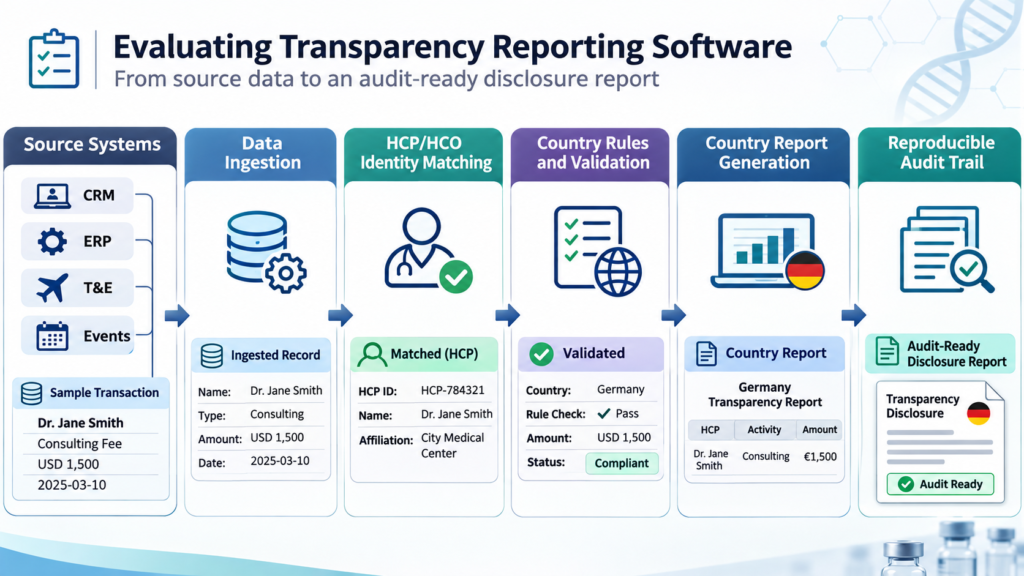
- Transparency reporting software is easiest to judge by following a sample of your own data from source systems through to the reports you file.
- Report templates decide how a disclosure looks. Recipient identity matching decides whether it’s right. If a payment is matched to the wrong recipient, no template will catch it.”
- Country rules change often, so check whether administrators can change rules without touching data that has already been reported.
- A useful audit trail lets you reproduce any filed report, including the user, time and inputs that produced it.
- Building in-house usually looks cheaper at the start and costs more once a third or fourth country comes into scope.
Choosing transparency reporting software gets harder with every country you report in. The Physician Payments Sunshine Act requires Open Payments submissions in the US, the EFPIA Disclosure Code sets the baseline across much of Europe, and national laws such as France’s Loi Bertrand add their own fields, categories and deadlines. A tool that handles one country’s format well can still struggle when it has to produce many different country formats from the same data.
This guide covers what to test when you evaluate options. For the rules themselves, see our overview of healthcare transparency reporting requirements.
Why Multi-Country Reporting Changes the Evaluation
Most transparency problems start before the reporting tool ever sees the data. Spend sits in customer relationship management (CRM), enterprise resource planning (ERP), travel and expense (T&E) and event systems, each with its own way of recording the same engagement. We cover those upstream issues in questioning data quality in transparency reporting.
For a software evaluation, the practical consequence is that the tool has to absorb that inconsistency without hiding it. It also has to support decisions about which parts of reporting are owned centrally and which stay with each country, a split we discuss in global vs local transparency reporting.
What to Look for in Transparency Reporting Software
Data Ingestion From Every Source System
Ask which systems the tool can take data from and how much transformation happens before the data arrives. At minimum, it should take feeds from your finance, CRM and event platforms as well as from outside vendors. Pay attention to what happens to a record that fails a check on the way in, since a tool that quietly drops bad rows will produce a clean report that is incomplete.
Recipient Identity Matching
Every payment needs to land on the right HCP or healthcare organization (HCO). Look for matching against external reference data rather than only your internal master data management (MDM) records, and for automatic matching on unique identifiers such as the National Provider Identifier (NPI) in the US. Ask how the tool handles a recipient who appears under two spellings in two markets.
Configurable Rules by Country
Thresholds, categories and recipient types differ by country and change often. The rules should be configurable by your own administrators, and a rule change should apply going forward without rewriting data that has already been reported. Check how fair market value (FMV) checks and validation rules are set up, and whether a non-technical user can read them.
Report Formats You Actually Need
List every format you file today and the ones you expect within two years, then ask the vendor to show each one. Coverage claims are easy to make, so ask to see a generated report for your two hardest countries. Multi-currency output matters too when your markets report in different currencies.
An Audit Trail Built for Questions
When an authority or an HCP disputes a figure, you need to show where it came from. The audit trail should log edits to individual records and also capture the user, time and parameters behind every generated report, so a filed report can be reproduced later.
Build, Buy or Partner
Teams usually weigh three routes.
- Building in-house gives full control and fits existing IT standards. The cost tends to appear later, as maintenance grows and each new country requires new mappings, categories and formats that someone has to research and code.
- Buying a dedicated platform brings prebuilt formats and rules and usually shortens deployment. The risk is rigidity. If the tool can’t reflect how your field teams, medical affairs events and contracts really work, people will work around it and the data will suffer.
- Working with a partner that combines software with hands-on support helps when internal teams are stretched. A partner like this can take on the operational work around the platform, from data intake through to submissions, and can also help you keep up with country changes, for example by tracking new requirements and calibrating validation rules so they catch real errors without flooding reviewers.
Questions to Ask Every Vendor
- Which source systems do you ingest from today, and what happens to records that fail validation?
- How do you match recipients, and which reference data do you use?
- Can our administrators change rules, and does a change affect data already reported?
- Can you show a generated report for each country we file in?
- What does the audit trail record when a report is generated?
- How quickly do you update formats when a country changes its requirements?
- What validation documentation do you provide for our quality framework?
How SpendMate Approaches Global Transparency
SpendMate consolidates spend from finance, CRM and event platforms and from third-party vendors in a single place. It matches recipients using Veeva Open Data, can work with other vendors’ reference data, and auto-matches profiles on identifiers such as the NPI number.
Its business logic engine lets users add or remove attributes and rules without affecting legacy data, and it applies configurable validation rules and automated FMV checks before data reaches a report. Reports cover the EFPIA Disclosure Code, MedTech Europe, European local laws, US Open Payments, Patient Organization disclosures, Loi Bertrand, Brazil, Australia, Mexico, Colombia and more, and they can be generated in different currencies. Every generated report is logged with the user, the time and the input parameters behind it. Cresen also releases a quarterly report on transparency regulations around the world for SpendMate clients.
For teams that want help running the program, SpendMate is available with managed services. Cresen can lead implementation and translate compliance needs into platform requirements, onboard new data vendors and map their file formats, and handle incoming transparency data through normalization, de-duplication and issue resolution. The team also maintains master data accuracy, monitors data flows for inconsistencies, runs data validation, generates reports and manages submissions. Day to day, a single point of contact handles enhancement requests, troubleshooting and change requests, so the service works as an extension of your compliance team.
To see a sample of your own data move through to the reports you file, book a SpendMate demo.
Frequently Asked Questions
What is transparency reporting software?
It’s software that collects spend with healthcare professionals and organizations from source systems, validates it, matches it to the right recipients and produces disclosure reports in each country’s required format.
Should we build or buy transparency reporting software?
Building can work for a single market. Once you report in several countries, the effort of maintaining country-specific categories, formats and rule changes usually makes a dedicated platform more practical.
What matters most when comparing tools?
Recipient matching, configurable country rules, report formats for every country you file in and a reproducible audit trail. Templates and matching work together, since even a well-built template can’t correct a payment assigned to the wrong recipient.
How do we test a vendor’s country coverage?
Ask for a generated report in your most complex markets, using sample data that resembles yours, rather than relying on a list of supported formats.
Can a vendor run our transparency submissions for us?
Yes. Some providers offer managed services alongside the software. With SpendMate, Cresen’s team can manage data intake, validation, report generation and submissions, while your compliance team keeps decision-making and oversight.